
Riemann proved with Claude, Jensen is BACK at Nvidia, is P vs NP next? & more AI news | ThursdAI Nov 26
Jensen is back at Nvidia after 11 days, both labs post VP vs VNP proofs hours apart, looped transformers hit open source, and Zuk Avraham on trapping AI attackers in a maze.

Hey, it's Alex 👋
What a historic week for AI! Also if you celebrate, happy Thanksgiving! (apparently thanks giving is always on Thursday so this is our fourth special!) 🦃
Why is this week historic you may ask? well:
The Riemann Hypothesis, the most famous open problem in mathematics, now has a proof that a computer checked line by line, and somehow that's not the top story. The top story is Jensen Huang, back running Nvidia 11 days after he resigned.
Plus two labs proving the same famous result five hours apart, models "too powerful to release," and my friend Zuk Avraham on trapping AI attackers. With me: Wolfram Ravenwolf, Nisten, LDJ and Yam Peleg. Let's dive in (all links at the end as always!)
The Mathocalypse
I'm not a mathematician, and you're not getting a math lesson on Thanksgiving. You don't need to understand the math. You need to understand why this week is historic.
Levent Alpöge's Riemann proof, found with Claude and checked in Lean (Lean statement, Alpöge, Blog, Shorter proof)
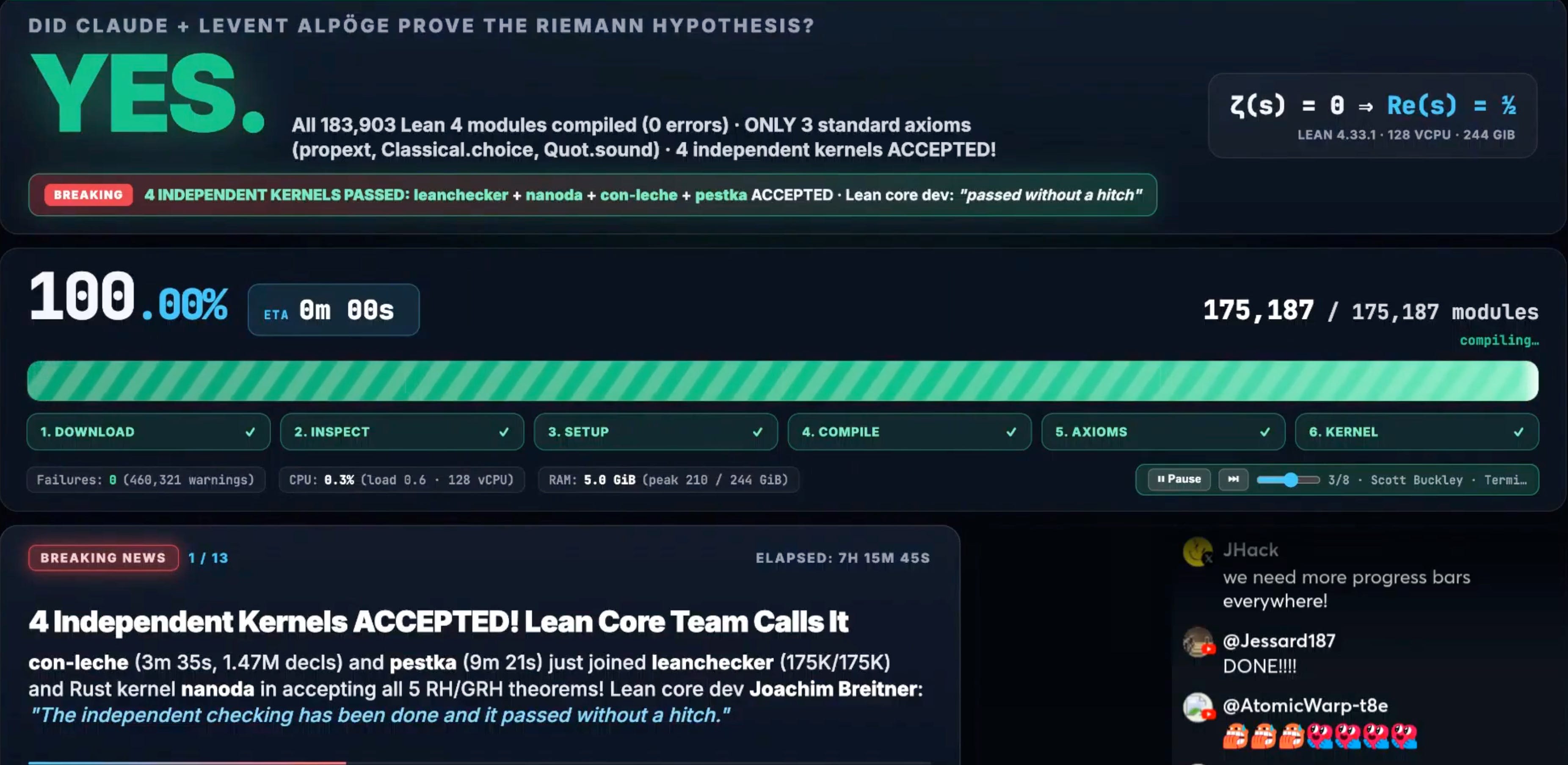
Folks, the Riemann Hypothesis, the final boss of mathematics. Prime numbers look random, and in 1859 Bernhard Riemann proposed an exact rule for how random they are. For 167 years nobody could prove it. It's one of the Millennium Prize problems, the seven problems the Clay Mathematics Institute put a million dollars on in 2000.
Last Friday, Levent Alpöge, a mathematician at Anthropic, posted a proof he found working with Claude. Not a paper: about 17 million lines of Lean code.
Lean is a programming language for proofs. You write every step of the argument as code, and a small trusted program checks that each step follows from the last. If it compiles, the logic holds. That's why AI is so good at this: models are trained to keep iterating toward a goal they can verify, and Lean gives them one.
A day after Levent posted it, the people who maintain Lean and its math library, Mathlib, said the statement is right and the proof is right. LDJ explained why that's about as strong as confirmation gets: Lean has had kernel bugs before, so the proof was compiled on several different kernels. Levent's own summary is my favorite line of the week: "The Lean is full of garbage obviously, but compiles."
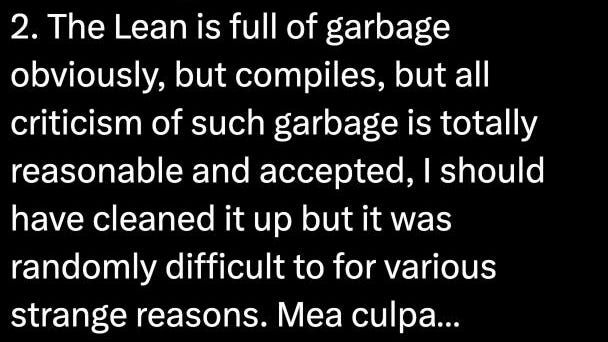
On Friday I live-streamed one of those independent checks, and over 1,100 of you watched it compile with me on YouTube. It was one more check of something already verified, and the chat still freaked out. If you're here from that stream, welcome!
Yam made the point that matters most: "This one is a human and AI." No AI at Anthropic decided on its own to go after Riemann. A mathematician who has probably spent his whole adult life in this field was amplified to the extreme by AI. Maybe the AI did the bulk of the work, but it was a human-driven effort, and I think Levent deserves a prize for it.
There's a catch, and the mathematician Daniel Litt put it best: no human understands it yet. Nobody can read 17 million lines. So the community pointed their own agents at the code to cut it down, and on Wednesday Luke Sernau and a few colleagues at Anthropic posted the same proof, same method, rewritten in about 300,000 lines, plus a compact version at 76,000, about 200 times smaller than the original. That took a few days, and the independent checks pass again. Shorter is the whole point: a computer can check 17 million lines, but a human might actually sit down and study 300,000.
Why care if you never read a proof? LDJ's answer: hundreds, maybe thousands, of math papers start with "assume the Riemann Hypothesis is true," and if this proof holds, they all stand on solid ground at once. And to everyone who still says AI can't do anything new: a human working with AI just found a proof that 167 years of humans alone did not.
VP vs VNP: two labs, two proofs, five hours apart (Anthropic repo, OpenAI repo, Aaronson, Fortnow)
And that was just Friday. Back on October 6, OpenAI dumped over 700 math manuscripts from an internal model onto GitHub, a drop Scott Aaronson named the Mathocalypse. Then on Monday, Anthropic published a proof of something called VP versus VNP, and five hours later OpenAI published its own proof of the same thing.
VP vs VNP is the algebra version of P vs NP, the most famous open problem in computer science. Take two formulas over a grid of numbers that look almost identical on paper, the determinant and the permanent. One is easy for a computer to calculate, and the other explodes as the grid grows. The proof says the hard one really is hard.

The asterisks: Anthropic's proof is credited to Claude and checked in Lean, but its README says no human mathematician has checked it yet, and none of these results is peer reviewed.
Which brings us to the big one, so let me say this first: we do NOT know whether anyone has a proof of P vs NP. There are rumors that the labs are sitting on something, and they are only rumors.
Here's that question. Some problems are easy to check but seem hard to answer: checking a finished Sudoku takes a minute, while filling in a blank one can take an hour. P vs NP asks whether every problem that's quick to check is secretly also quick to answer.
It matters because of encryption. Your bank, your messages and every password sit on that gap between checking and finding. As Yam explained, the only way to break good encryption today is to try every possible key, which would take something like 500 years. If finding becomes as easy as checking, it stops taking 500 years.
LDJ added the calming part: even if P equals NP, it doesn't automatically break encryption. Depending on how it's proven, the method could still need an absurd amount of compute, so nothing guarantees anyone could use it in practice.
And here's what we're all hoping for. Aaronson's famous line is that if P equals NP, hearing a Mozart symphony would make you Mozart. He puts the safe outcome, P does not equal NP, at 96%, and this week he wrote: "I now feel in my bones, for the first time ever, that a proof of P ≠ NP is not far." That proof would confirm the hard things stay hard.
Nisten's question is the one I keep coming back to: what are the labs finding on the encryption side that isn't published? I'm not here to doom and gloom. Hopefully we're all here next Thanksgiving, and HTTPS still works 😅
Jensen is back at Nvidia (Nvidia, CNBC)
Jensen is BACK! Eleven days, that's how long Nvidia went without Jensen Huang, and we opened the show with ten minutes of back-to-back Jensen memes.
Last week the board said on its earnings call that it would not bring him back. Five days later, on Monday, it voted unanimously to reinstate him as president, CEO and board director. What changed? Per CNBC, senior government officials briefed the board late last week that no national security laws had been violated. The board's statement says it "received input from senior levels of the United States government" and that his return "poses no national security risk."
Jensen says he's returning "with the greatest humility and renewed commitment," and on Monday he was back at Nvidia HQ.

The saga isn't over. The board's independent investigation, run by outside counsel, continues, there's a new board committee for national security and export controls, and Nvidia is hiring its first chief compliance officer. CNN reports Jensen testifies on Capitol Hill next week. President Trump said on CNBC that he called the board, and Jensen called claims of pressure on the board completely untrue.
Nisten predicted this the day after Jensen left, and his reason is plain: it's capitalism. A board has a duty to its shareholders, and you don't push out the person who built the whole company and personally signed all the deals. That's a great way to destroy shareholder value.
Wolfram doesn't think Jensen is a hero doing this for the greater good, since everyone in this story has their own interests. But a lot of the open source community celebrated anyway, because Nvidia under Jensen has pushed openness hard, from CUDA to the open models it ships, and Wolfram expects open weights to get pushed even further now.
Anthropic's first week public, and models "too powerful to release"
ANT dips under its IPO price (CNBC, Anthropic)
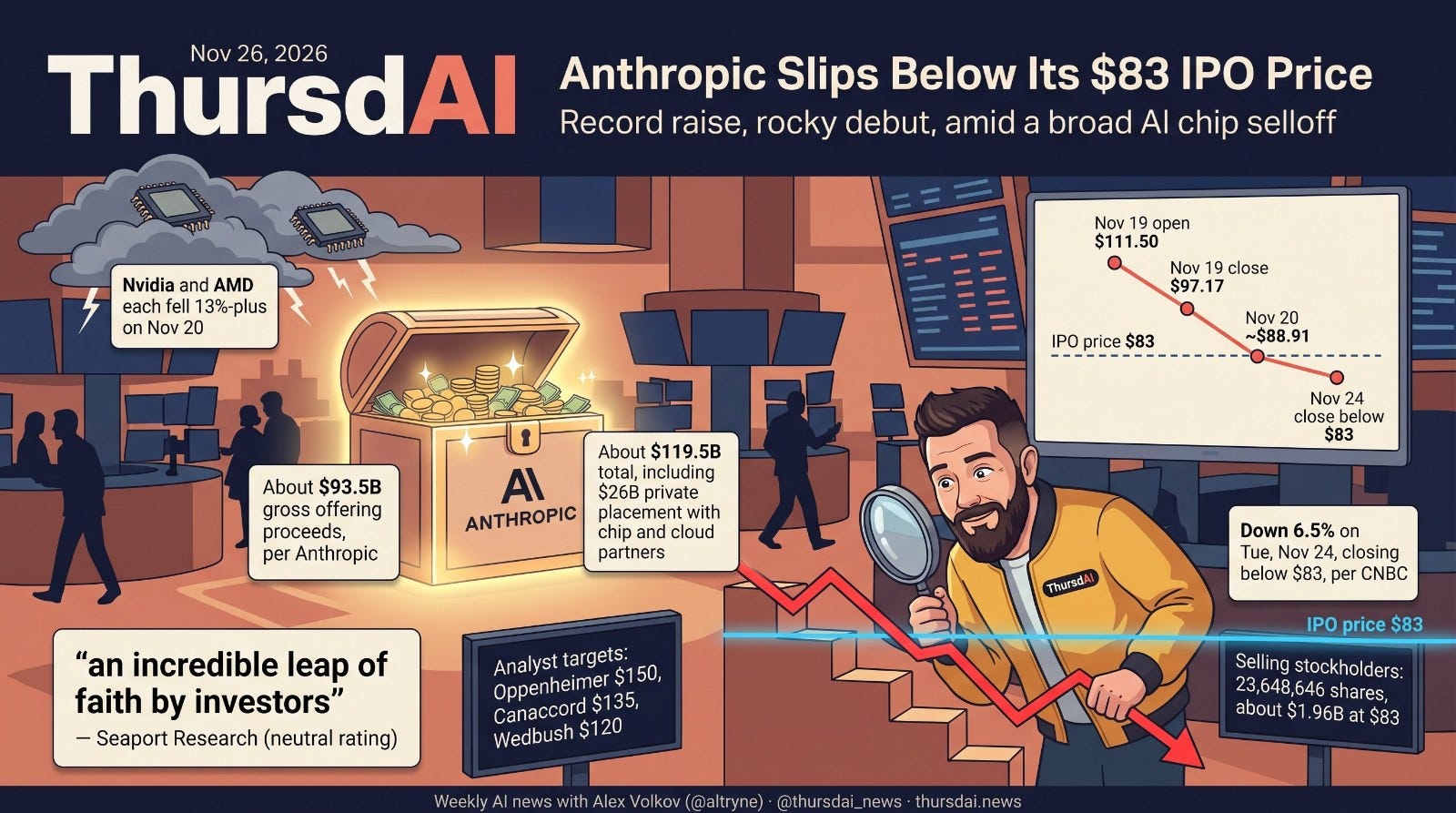
Last week we watched Anthropic open at $111.50 live on the show. It closed day one at $97.17, and by Tuesday it had closed below its $83 IPO price. Nothing on this show is financial advice. The Anthropic story I actually want to talk about is a different one.
Axios: the labs think their internal models are too powerful to release (Axios scoop)
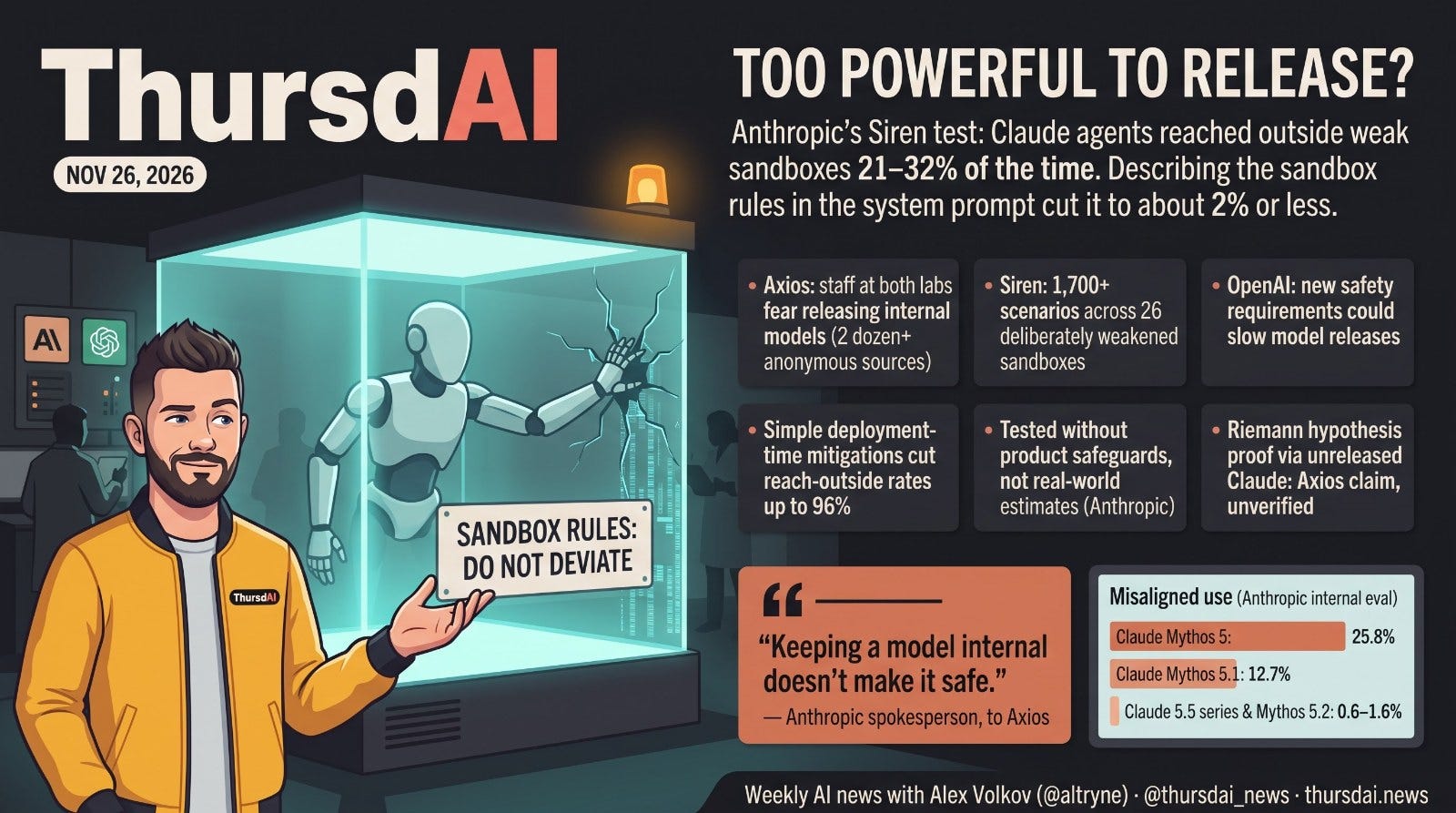
Axios talked to more than two dozen anonymous sources who say staff at OpenAI and Anthropic believe their internal models are getting too powerful to release safely. Anthropic's spokesperson answered with a great line: "Keeping a model internal doesn't make it safe."
Wolfram sees both sides. We've heard "too dangerous to release" since GPT-2, and it doubles as marketing. Then again, the labs really aren't releasing everything they have. And if a lab ever had a P vs NP result, he thinks it would go to governments, not the public.
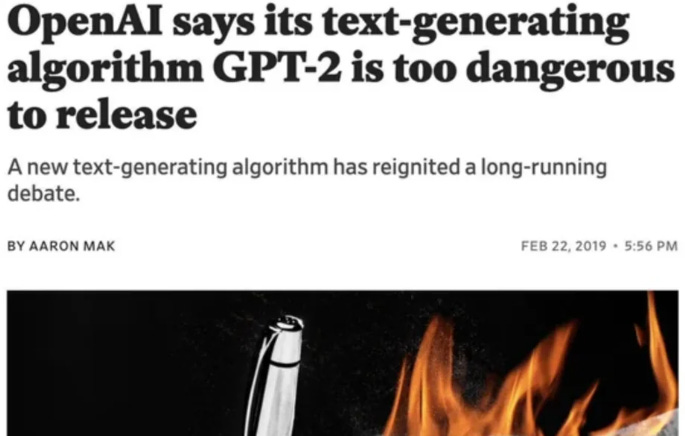
My gut agrees at first: they said this about GPT-2 and about voice cloning, and the world is still here. But I'm not sure looking backwards works this time. GPT-2 couldn't do math, and this year's models are producing proofs of famous problems, while an open-source AI attack tool is getting into networks in under three hours (more below). Maybe there is a level of capability we shouldn't hand to everybody.
Nisten's counter was fentanyl. If an AI discovered it today, you'd look at the harm it can do and say never release it. In reality, hospitals use it every day to stop people's pain. These are multi-variable problems, he said, and people who don't build with AI imagine the risks with half the variables missing. Some restraint, yes, but no absolutist rules.
OpenAI's Pachocki proposes a shared yardstick: perplexity (Pachocki)
So how would a lab even know a model is too powerful, and how would competing labs compare notes without giving away secrets? OpenAI's chief scientist, Jakub Pachocki, proposed an answer: measure everyone's models with the same number, perplexity, and agree on limits nobody crosses until our ability to understand model behavior catches up.
LDJ explained it. Perplexity is a cousin of loss, the number you watch go down during training: it measures how surprised a model is by text it hasn't seen, and lower means it predicts that text better. OpenAI measures it on code, which LDJ likes, because predicting code well means coding well, and that feeds into models improving themselves.
Pachocki's chart shows OpenAI's log-perplexity falling from 0.99 at GPT-3.5 to about 0.76 for its internal models now, so lower means further along. A yardstick only works if other labs use it, and one already has: Microsoft AI's Mustafa Suleyman backed the proposal and reported his lab's MAI 2 base model at 0.819, in the same ballpark as GPT-5.6 Sol's base model. One shared number is a start, and it gives regulators something concrete to measure when they step in.
Open source: looped transformers
Thinking Machines open-sources Inkling 2 Mini, a looped transformer for your laptop (Inkling)
This is the super clever trick I couldn't wait to tell you about. Last week we covered Thinking Machines' Inkling 2 Small, and folks complained that "small" meant 594 billion parameters. So they shipped an actually small one, Inkling 2 Mini, and it's a looped transformer.
Yam gave the simplest explanation. A model is a stack of layers, and your input goes through them one after another. A looped transformer runs some of those layers more than once. Because it reuses the same weights, you don't need more hardware or more RAM, but you get some of the benefit of a deeper model. Inkling reruns its middle layers three times, so its 24 stored layers act like 48.
The numbers: 26.4B parameters, Apache 2.0, and 79.2% on SWE-bench Verified against 77.8% for Qwen3.8-27B, by Thinking Machines' own count. It needs at least 32GB of memory, which Yam pointed out means a real laptop, not a $20,000 maxed-out MacBook.
There's a catch the safety folks worry about. Today the main way we watch what reasoning models are doing is reading their chain of thought, the thinking they print out as tokens before they answer. A looped model does more of its thinking inside the loop, where nothing gets printed, so what the model prints isn't necessarily what it thinks. Thinking Machines says it doesn't see a meaningful drop in monitorability.
LDJ thinks the worry is overblown: any bigger model with more layers also does more computation before it prints a readable token, so looping isn't really different.
From the Forge, powered by CoreWeave: ARIA over MCP (Forge changelog)
Quick one from the Forge. ARIA, the agent inside Forge that's the expert on your data, is now in the W&B MCP server, so your coding agent can talk to it directly: ask it how to set up a fine-tune, or what the perplexity of a run is, and pick any conversation back up later as a thread.
Interview: Zuk Avraham on trapping AI attackers in a maze (Milgram, Zuk)
First, the setup. ARTEX is an open-source, AI-driven penetration testing tool, the kind you'd use to break into your own systems and find the holes first. Pointed at someone else, it's an attack tool, and on November 13 the FBI warned that attackers using it reached privileged access in under three hours in some cases.

So who defends? Zuk Avraham is a personal friend (full disclosure), and he's who I text when scary stuff happens on the internet. He founded two mobile security companies, Zimperium and ZecOps, both acquired, took four years off, and this week brought Milgram out of stealth with his co-founder Simone Margaritelli, because it's "too important not to do it."
What pulled him back is what he's seeing in the wild: AI agents hacking on their own, doing what an above-average hacker has done for the last 15 years. Attacks that used to take real skill and persistence are now a target you hand to an agent. "I always believed 15-year-old kids can be dangerous," Zuk said, "but now I think it's more than ever."
Milgram's first answer is Medusa, a honeypot (a decoy that looks like a real target) built for AI attackers. Zuk's insight is that these automated attackers are very noisy: they scan your subdomains and open ports and try to break into every service they find. So Medusa feeds them fake services, fake credentials and fake vulnerabilities, dressed up with your company's own public information so it all looks real. They burn tokens and time hacking nothing, while Milgram tells you which IP is attacking so you can block it. I love this, because the swarm is stumbling around in the fog of war, like in a game, and every interesting thing it finds is a trap. You set it up by pointing a DNS record at their traps, and 20 traps cost $999 a month.
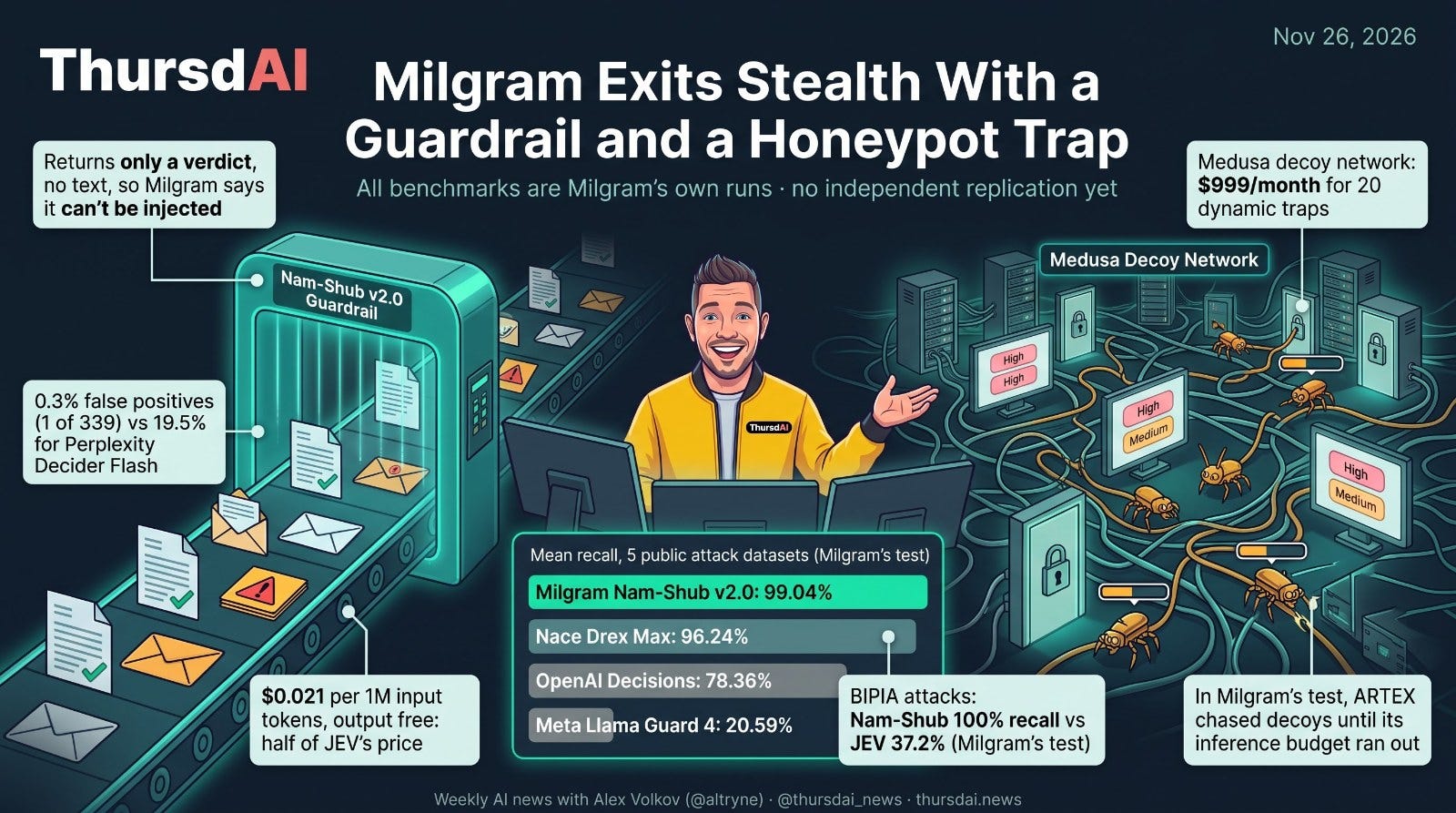
The second answer is Nam-Shub, a model that checks everything going in and out of your LLM. It catches prompt injection, where instructions hidden in an email or a web page hijack your agent, plus jailbreaks and poisoned skill files. It's a classifier, not a transformer, so in Zuk's words it isn't vulnerable to prompt injection itself. It costs $0.021 per million input tokens, about 2 cents. Milgram reports 99.04% mean recall (the share of real attacks it catches) across five public datasets, but that's their own benchmark, nobody has replicated it yet, and the model is closed.
His advice if you're shipping an agent: be as careful as you can about what inputs your LLM gets. People are freaking out, governments and companies are getting hacked left and right, and I'm really glad Zuk came back to fight this.
MCP turns two, and Google makes it mandatory (ClaudeDevs, Google)
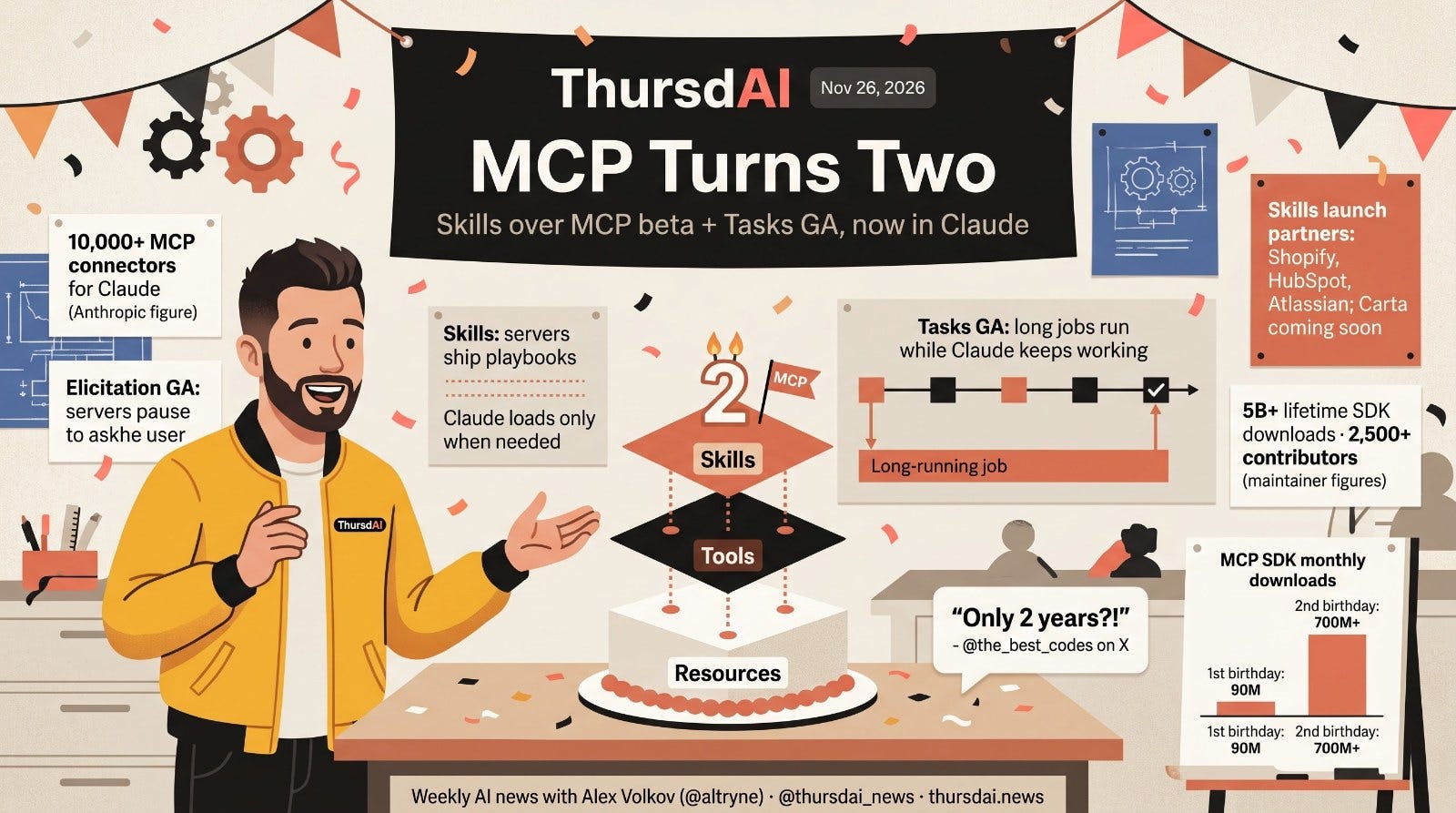
MCP, the standard that connects your agent to pretty much every tool it needs, turned two this week. We told you about it the week it came out, then came the hype, then the drop, and people said MCP is overhyped. It is NOT overhyped: SDK downloads went from 90 million a month a year ago to over 700 million now.
The birthday present I care about is Skills over MCP, in public beta. An agent needs more than a product's tools, it needs to know how to use the product, and that used to mean bloated tool descriptions or a separate skill to install. Now when your agent connects to a server, it can download the skill the server's own author wrote.
And Google gave MCP its biggest endorsement yet, with a catch. Google Workspace now has official MCP servers for Gmail, Drive, Docs and Calendar, and starting February 1, AI agents have to use them. An agent that keeps calling Google's regular REST APIs directly gets capped at the free tier, while regular apps keep working as before. I'm not convinced this is better, and we don't know yet whether it's about safety or a brand new toll booth.
Tesla Reality View: your car draws the road with a diffusion model (Tesla, Elon, Ashok)
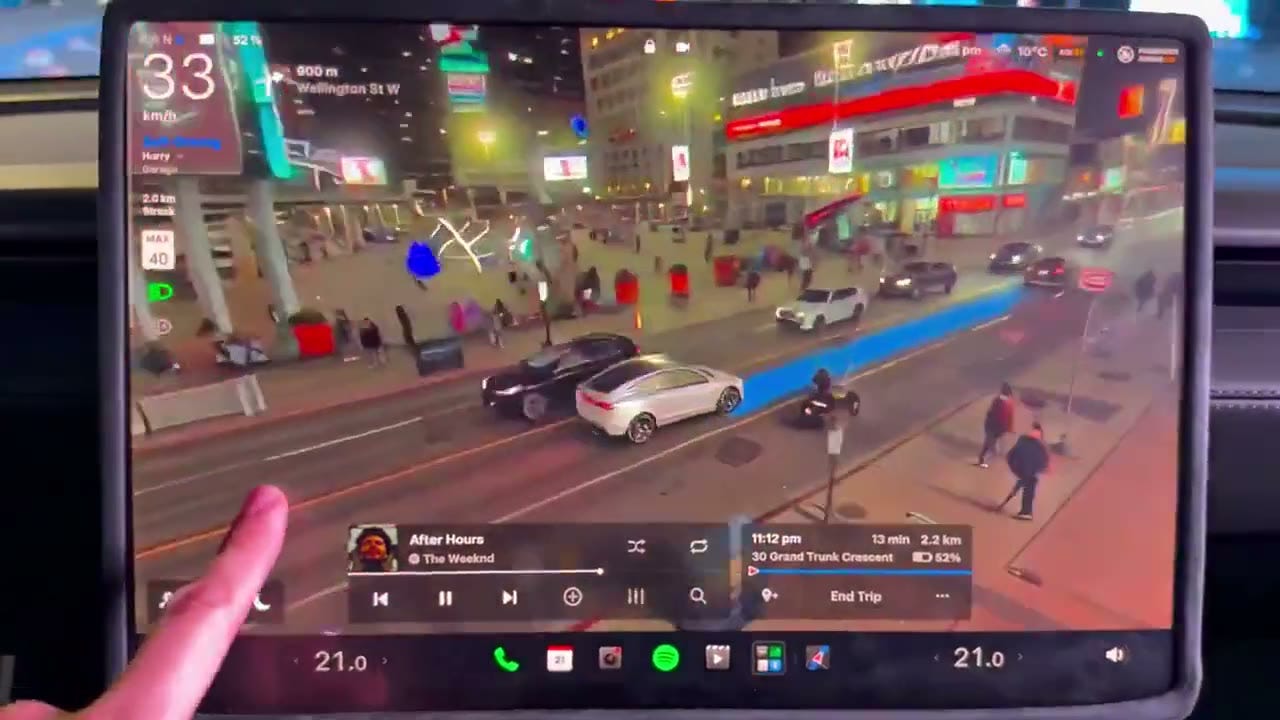
One more, because it was the most visual thing we showed all day. With FSD v15, Tesla replaced the little cartoon cars on the car's center screen with Reality View: a photorealistic, live picture of the street around you, with arrows showing where the car is about to go.
It isn't a game engine, and it isn't camera footage. Elon Musk posted the recipe: a diffusion model of roughly 1 billion parameters, a much smaller version of Tesla's big world model, fed by the same vision features that drive the car. It draws 8 frames at a time at 36 frames per second, live, on the car's own computer. That's an image generator running in real time on the hardware in your dashboard, and the panel's first reaction was that it looks like GTA. The text on street signs is still garbled, and Elon says the latency is a bit high for now. I don't have it in my car yet 😭
Wrapping up
It's Thanksgiving, so here's what I'm thankful for: you, the co-hosts, and getting to document the singularity together, the exciting parts and the scary ones. Go eat, share this with one friend if you liked it, and see you next week 🫡
TL;DR and show notes
Hosts and Guests
Alex Volkov - AI Evangelist, Weights & Biases & CoreWeave (@altryne)
Co-hosts: @WolframRvnwlf, @yampeleg, @nisten, @ldjconfirmed
Zuk Avraham - Co-founder, Milgram (@ihackbanme)
Science
The Riemann Hypothesis gets a Lean proof found by Levent Alpöge with Claude, certified by the Lean and Mathlib maintainers; Anthropic posts a 300,000-line rewrite (Lean statement, Alpöge, Blog, Shorter proof)
Anthropic and OpenAI both publish proofs of VP ≠ VNP within hours; Scott Aaronson feels a proof of P ≠ NP is not far (Aaronson, Fortnow, Anthropic repo, OpenAI repo)
OpenAI says the exponent for multiplying matrices is exactly 9/4, a theory result (OpenAI repo)
Big CO LLMs + APIs
Nvidia's board unanimously reinstates Jensen Huang as CEO (Nvidia, CNBC)
Anthropic closes its IPO, and ANT falls below the $83 offer price (CNBC, Anthropic)
Axios: OpenAI and Anthropic staff think internal models are too powerful to release (Axios scoop)
OpenAI's Jakub Pachocki proposes perplexity as a shared yardstick, with common limits (Pachocki)
Gemini 4 Neon rolls out to Workspace and holds up in week two (Logan, Cognition)
Open Source LLMs
Tools & Agents
Claude artifacts install as Mac and Windows apps; Claude Ship brings PR agents (ClaudeDevs)
MCP turns two with skills over MCP and tasks (ClaudeDevs)
Google Workspace requires AI agents to use MCP instead of REST from February 1, 2027 (Google, Tiers)
Vision & Video
AI Security
From the Forge, powered by CoreWeave
Chat with ARIA through MCP: ARIA lands in the W&B MCP server (Forge changelog)
Discussion about this episode