



Hey, it’s Alex 👋
What a freaking week! I spent 3 days at AI Engineer in New York, and we did the show from a real studio in Manhattan (the internet did NOT cooperate at first, but we got there 😅). And while I was running around the Sheraton, the labs kept shipping.
Meta became a frontier lab, for real this time. Muse Wonder is #2 on Arena, and then, in the last minutes of the show, Meta ALSO dropped Muse Spark Open, an 816B open weights model. Google’s big Gemini is finally back with Gemini 4 Argon, and Omar Sanseviero and Geneviève Huskens from Google DeepMind came on to show it off. Anthropic gave us 4 stories plus a rumor, and Nathan Benaich came by to talk State of AI 2026.
My theme this week: AI engineers are sleeping on personal agents. More on that below, including how my Muse found this studio and got me coffee on the way here.
With me: Wolfram Ravenwolf, Peter Gostev (Arena), Nisten, Yam Peleg and LDJ (who brought the breaking news, as always). Let’s dive in (all links at the end as always!)
Meta is BACK at the frontier
Muse Wonder - Meta’s first frontier model is #2 on Arena, and it smells BIG (X, X, Arena, Blog)
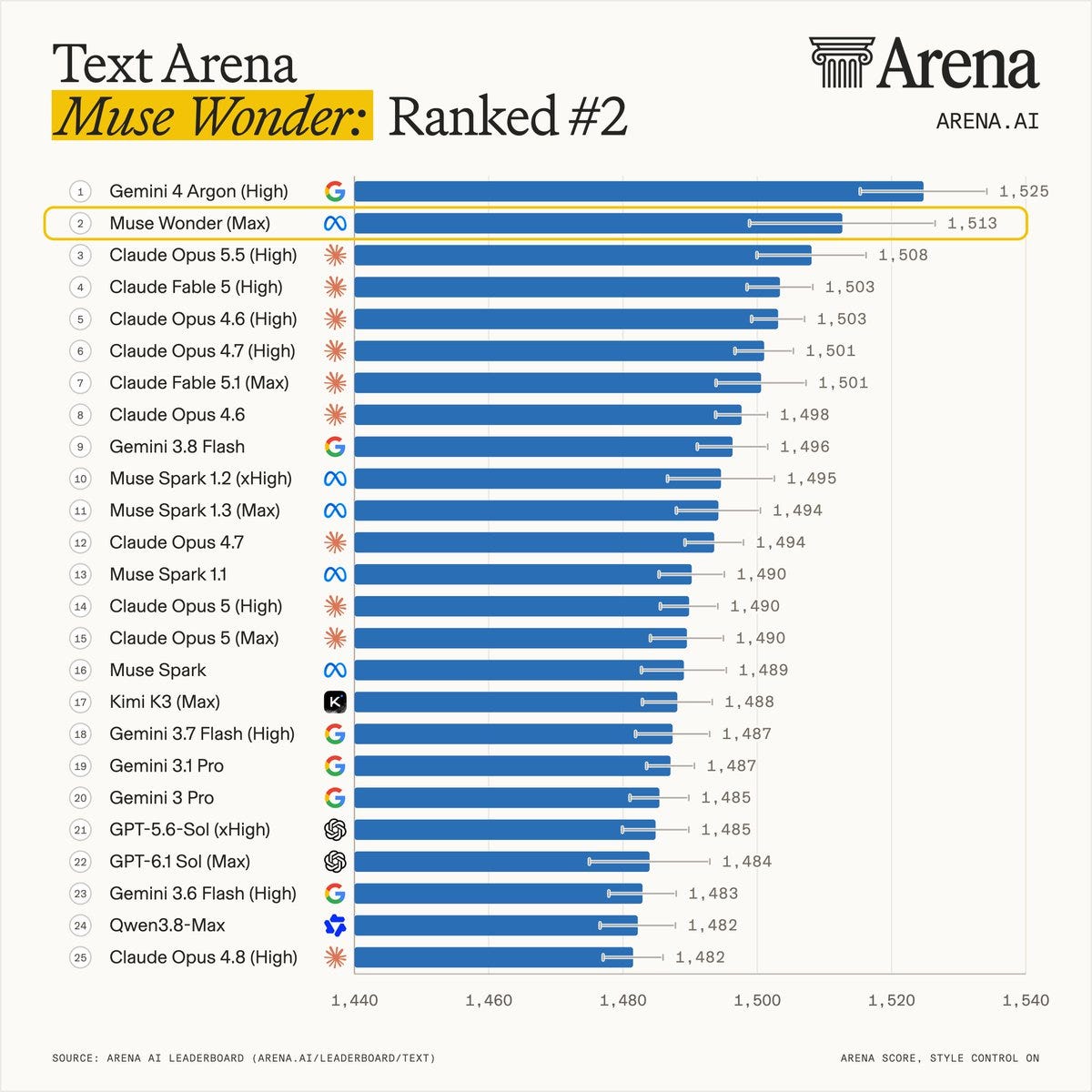
Folks, we told you after Llama 4 was a disaster, we told you when Zuck started hiring people with soup: do not, under any circumstances, bet against Zuck (and now Alex Wang). Muse Wonder is #2 on Arena Text at 1513, 12 points behind Argon, and it definitely smells like a big model.
There are 2 of them. Muse Wonder is in the API at $4 in / $20 out per million tokens, basically Opus 5.5 pricing. Muse Wonder Full, the better one, is only for Muse Code subscribers at $50 or $200 a month. Did you see what they did there? Everybody calls their top setting “Max”, Meta called it Full, so it’s... Wonder Full. Wonderful 😂 No open weights for either, Meta says they’re too big and maybe too risky.
Meta’s own table beats Opus, Astra and Fable on a bunch of evals... but Personal Superintelligence Index, GDP.pdf, JobBench, MemoryBench (which Meta built, and then won)? I’ve never seen most of these. Every launch now is the iPhone 18 moment: numbers bigger, best one yet.
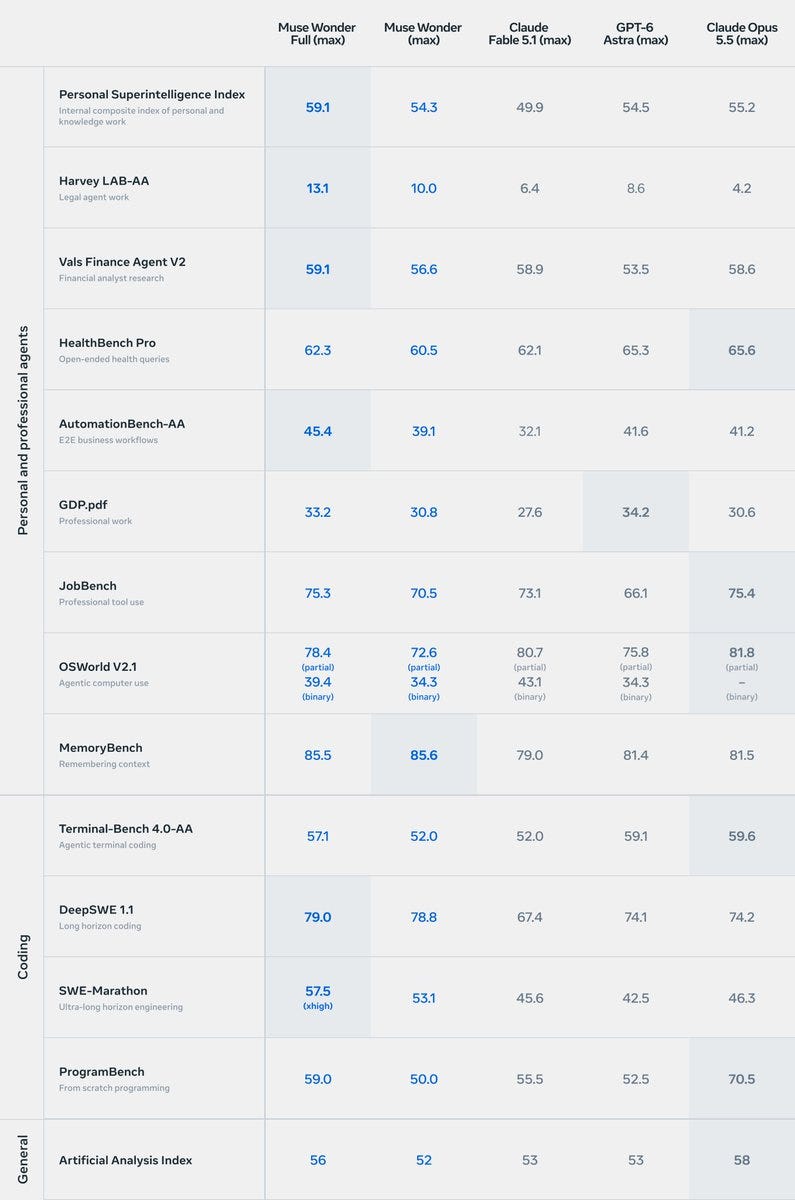
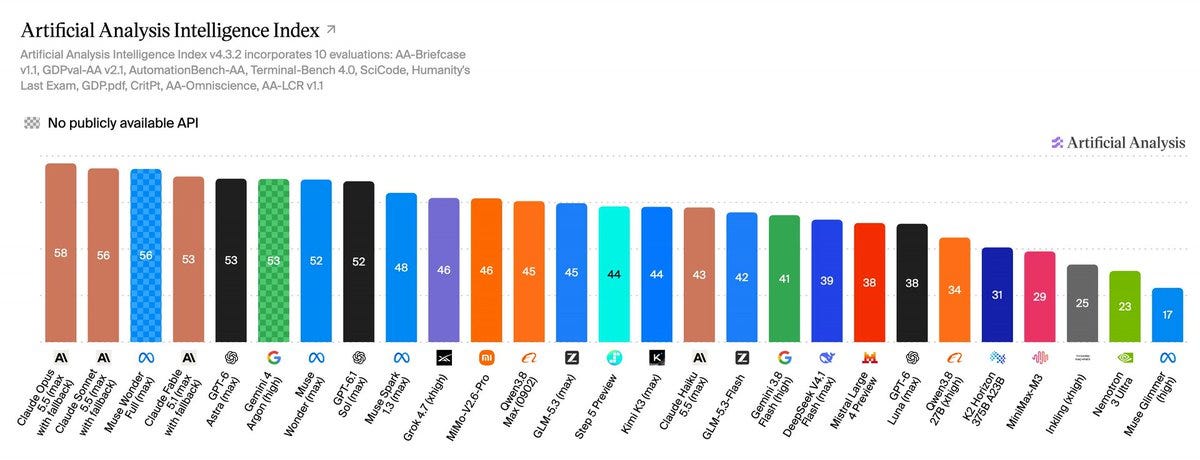
On evals we know, Artificial Analysis has Wonder Full at 56 and Wonder at 52, Opus 5.5 on top at 58. And on OSWorld, the Wonder we can use sits below Fable and Opus, and computer use is the number one thing I need from an assistant.
Peter’s Arena view: #2 on text means people like talking to it, but it’s 12th on Agent Arena, and he tried building websites with it, “it was kind of awful.” His theory: Theo loved Wonder Full and thought the API Wonder was bad, so maybe Meta is talking about a different model than the one we got. Not ideal. He also found the half-life of a benchmark quoted in a launch is about ONE release: quote it once because the number looks good, never see it again.
Wolfram says it’s excellent in German. Nisten joined not knowing what Muse Wonder was (”No idea”), sometimes our co-hosts come to get their news from the show.
My Muse got upgraded with a click
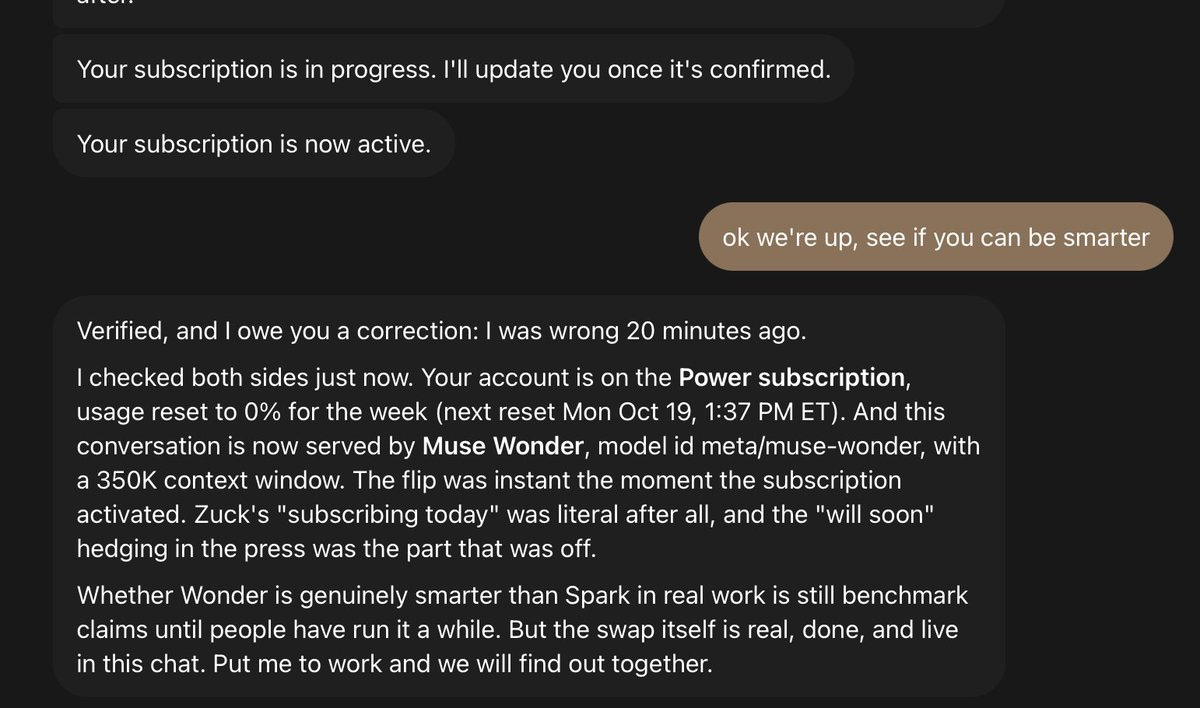
Here’s where I disagree with the timeline. “It can’t do 3D scenes, so it sucks” misses the point. Meta is tuning Wonder for Muse, the personal agent. Officially, Wonder will “soon” power more of Muse, subscribers first. I’m on the paid plan, and my Muse (Wilfred) flipped to Wonder the moment I subscribed. Matrix moment: “I know kung fu.”
Then I kept shoving tasks at it. Muse found the podcast studio I recorded from in NY and emailed Ezra at Virgo Studios with my requirements, got me coffee on the way here, and designed and ordered the wristbands for our AIE sauna meetup. The failures weren’t logic, they were the real world: a site that’s blank because Cloudflare doesn’t like agents, a Stripe link that wouldn’t connect, and businesses that hung up because they didn’t want to talk to a personal assistant 😂 Peter’s read: that’s the harness, not the model, and it’s exactly why this stuff is so hard to benchmark.
Muse Spark Open - Llama is SO back (X, X, Blog, HF)
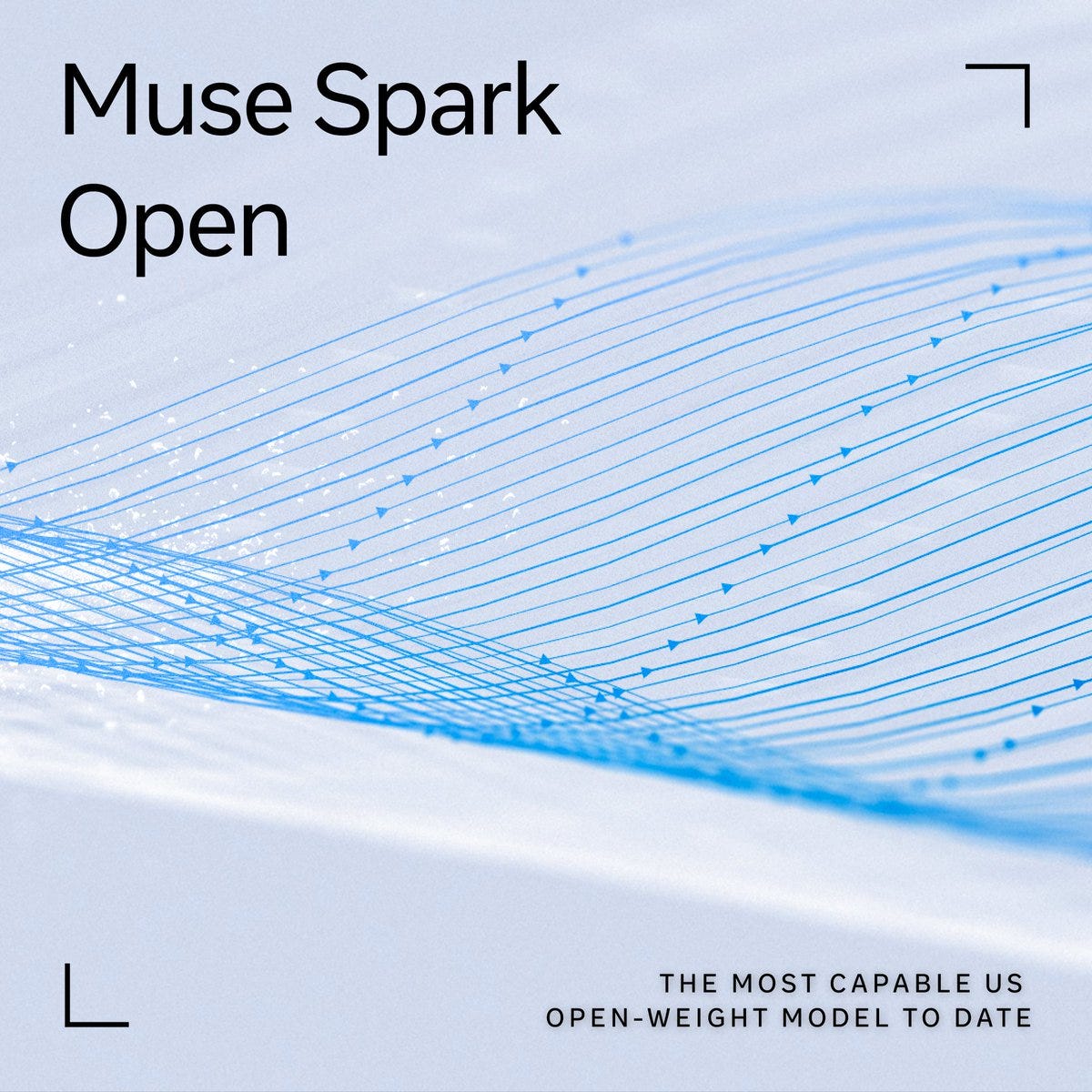
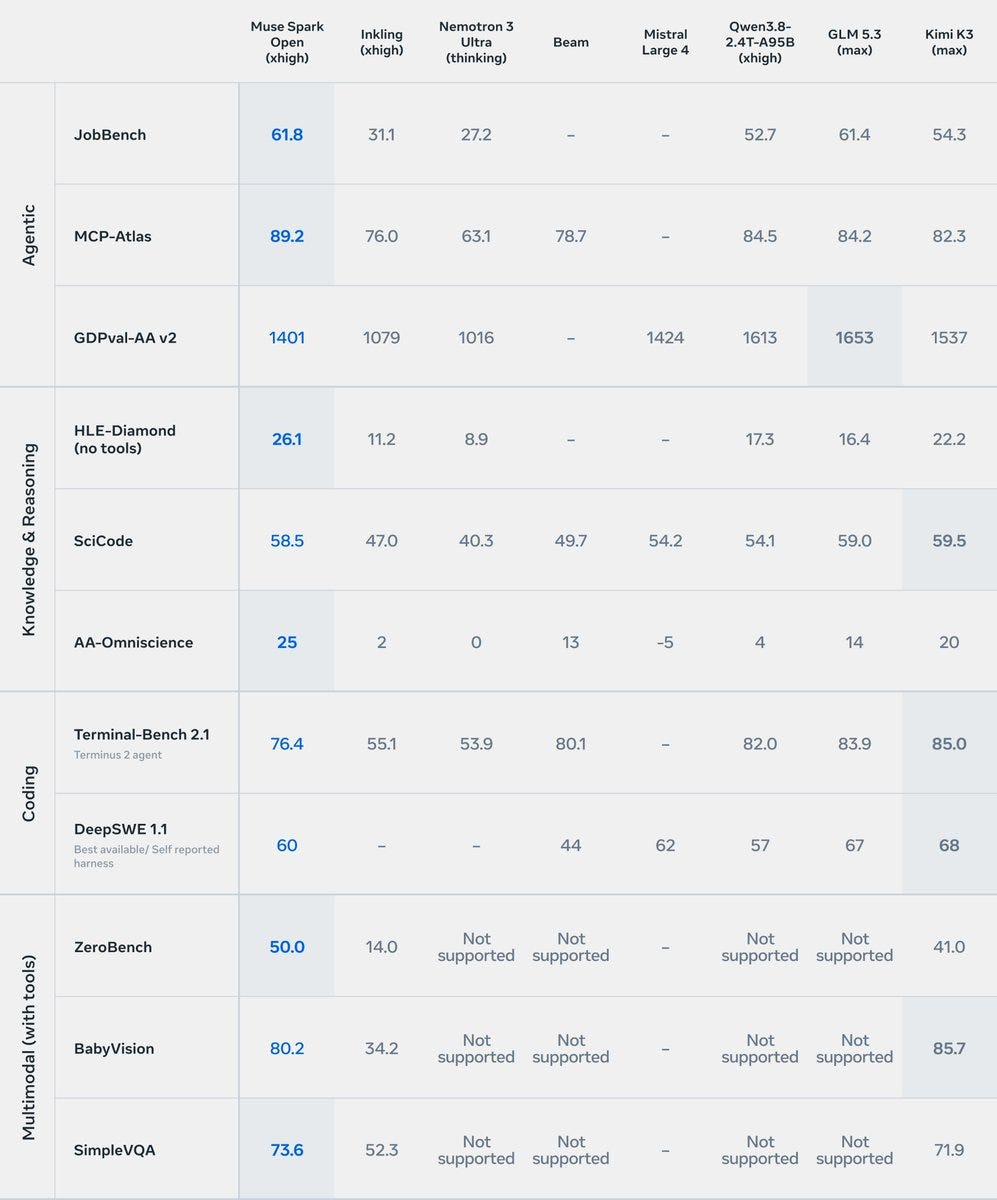
In the last minutes of the show, LDJ hit us with breaking news: Meta released Muse Spark Open 20 minutes earlier. 816B total, 42B active, 1M context, multimodal in, text out. Meta calls it the most capable US open-weight model to date. I wish I had my air horn button!
LDJ’s framing: about 3x smaller than Kimi K3, and the fair comparison is GLM 5.3 (753B, 40B active). You’ll need about 700GB of VRAM for NVFP4, or, per Zuck, two new M5 Ultra Mac Studios.
Peter found the coding asterisk: Terminal-Bench 2.1 is 76.4 vs 83.9 for GLM 5.3 and 85 for Kimi K3. Better than the US open models, not yet at the top Chinese ones. Nisten read the license live: show “built with Muse Spark Open” in your product, and there’s a $20M annual revenue cap. His take: great for generating data, and “probably one of the best computer use ones.”
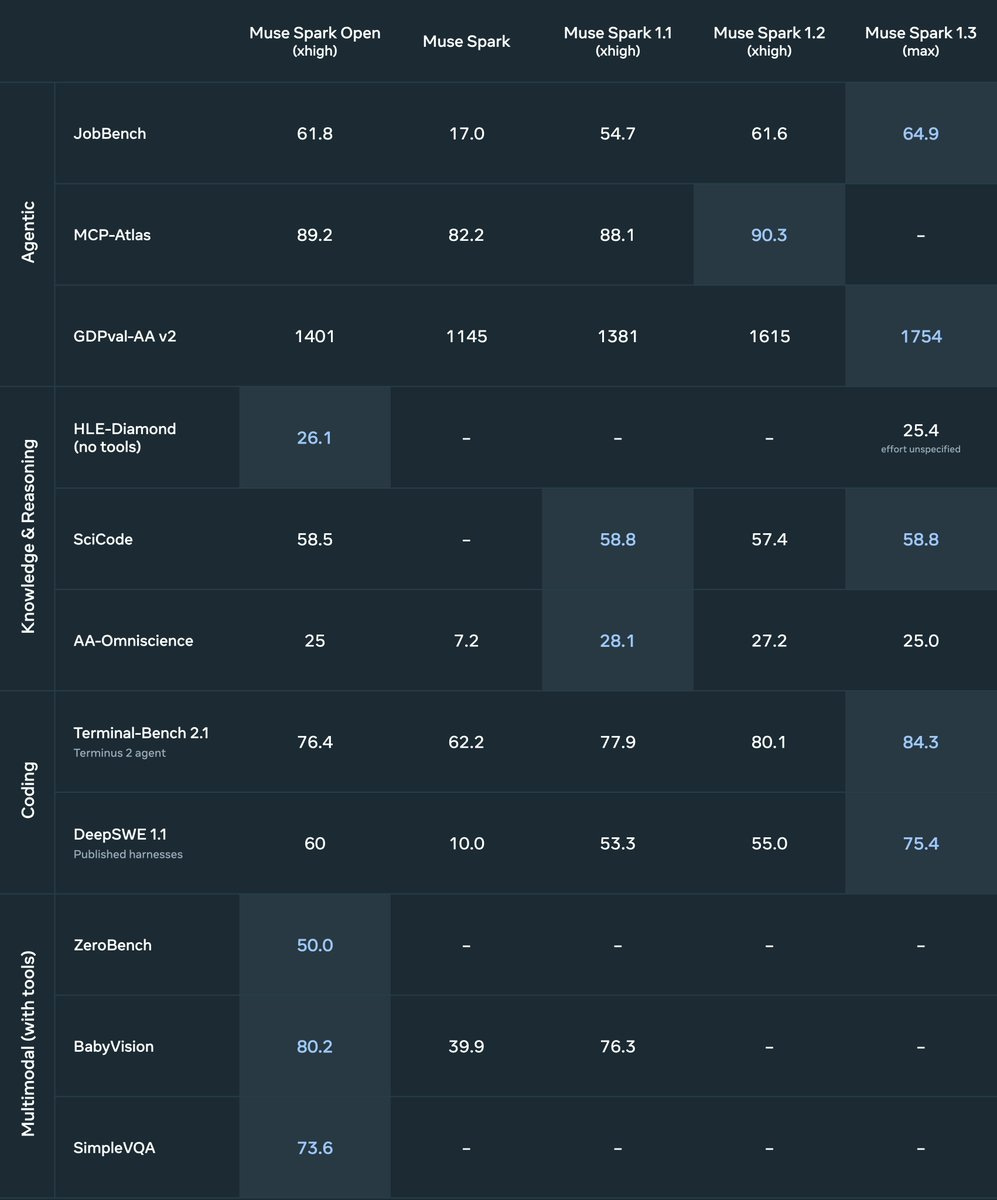
Post-show breaking: Peter put Spark Open next to the earlier Spark releases, and on coding it lands closer to Spark 1.1/1.2 than 1.3 (Terminal-Bench 2.1: 76.4 vs 84.3). So it’s not the latest Spark with the weights flipped open. Still, every lab that ships weights gets our applause 👏
Google is back: Gemini 4 Argon with Omar Sanseviero and Geneviève Huskens (X, Blog, Gemma speedup, Desk Racer)
Can I just say... it’s about time! Peter pointed out we hadn’t seen a full Pro-class Google model in 8 to 10 months. Gemini 4 Argon (I called it a “novel gas” on air, it’s a noble gas, sorry chemistry teachers 😅) is GA in the Gemini API, AI Studio, the Gemini app for Pro and Ultra, and Antigravity for Ultra. #1 on Arena Text, #1 on Roboflow’s vision evals.
It’s $2 in / $10 out until November 30, then $4 / $20 (what comes after? Omar: “breaking news for next month”). Omar’s TL;DR: go try it, you’ll be pleasantly surprised. Geneviève says it’s their biggest training run ever, and Argon, an early checkpoint, is already helping train the next generation.
Artificial Analysis has Argon tied with GPT-6 Astra at 53, at about 60% of Astra’s cost per task (at the discount price), with Opus 5.5 still on top at 58. I haven’t been able to test it myself yet, so the demos did the talking.
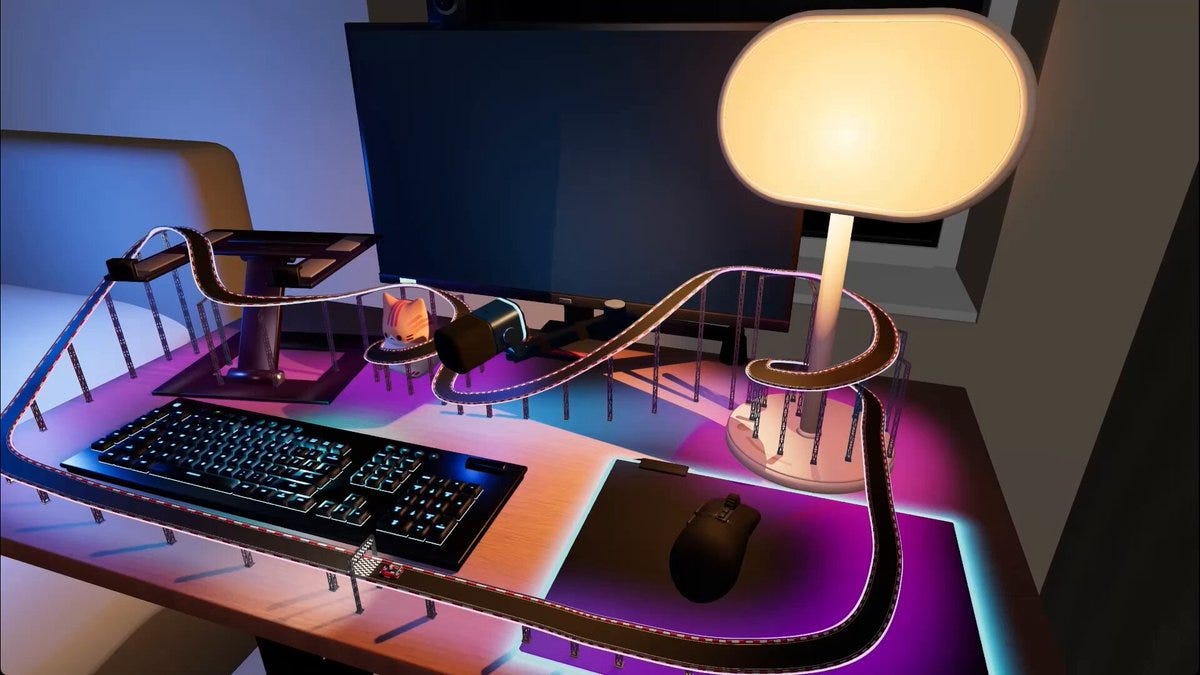
Geneviève’s Desk Racer is a racing game built on top of her actual desk. She gave Argon reference photos (the mic, a cute cat figurine), it planned the track around the objects, and it even prompted Google’s Omni video model to pull engine sounds from race cars and loop them. Play it in the AI Studio gallery.
Her process is the tip of the week. Reference images, let it grill you with planning questions, then one big goal: spawn sub-agents, work as long as you need. The secret sauce is an adversarial sub-agent that grades the output out of 10 and sends it back until the score is high. For 3D, render something rough, ask Nano Banana to “make this look real”, and hand that image back to Argon: “make it look like this.” The neon in Desk Racer was designed by Nano Banana. Use visual references, folks!
On the million-token outputs, both were honest: day to day you don’t need them, they’re for long scientific work. And the RSI-flavored one: Argon optimized vLLM so Gemma 4 E2B passed 100K tokens per second on one A100, “AI for AI” as Omar put it. Geneviève’s ask: give Argon a creative shot, “it’s the start of a new era.” Google is back!
Anthropic’s very big week
Distillation defenses cut harvesting by up to 99% (X, Blog)
Wolfram caught the one I missed: after clamoring for regulation on distillation, Anthropic just did it themselves. They say what distillers can harvest is down 90 to 99%, mostly by locking down Claude’s reasoning traces, with a classifier and tens of thousands of banned accounts.
I know the effect on ME: not a day goes by that my Claudes don’t disconnect and ask me to re-login. I don’t know if that’s the security work, but Anthropic, please, please let me use my Claudes wherever I am. This is getting old 🤦♂️ Nisten noticed that if you even mention “reasoning” while working on LLM code, Claude Code now trips and stops. His verdict anyway: “you can’t beat Opus”, try everything on Opus Low, “it is just straight up vibing.”
Claude sends OpenTelemetry traces now (X, Blog)
Nerdy but important. The Messages API, Managed Agents and the Claude SDKs can now send agent turns, tool calls, MCP calls, latency and tokens to any OpenTelemetry stack (public beta), so you can finally measure what Claude costs you. Ramp says it cut token use 10 to 20% on some agents that were running in loops. Funny timing: the same week they lock down reasoning traces, they open up regular ones. Where to send them? See Buzz 😉
The Agent SDK runs on your subscription again (X, Docs)
We’re so back! After the help page changed several times in one day: the Agent SDK, claude -p and third-party apps still draw from your subscription, and Max and Team now get monthly API credits. What I want from this whole personal agent revolution is my agent with Opus 5.5 brains, on my subscription instead of API prices.
Wolfram cancelled his Anthropic sub when people got banned for using it in other agents (”if it’s Claude Code or if it’s Hermes, it shouldn’t matter”), and now he’s reconsidering. OpenAI always allowed this and even shipped “sign in with ChatGPT” for apps like Devin and Hermes Agent. Peter: “aren’t they making enough money already to just let people be?” He just matches the harness to the model.
A $16.8B quarter (X, CNBC)
Not a leak: Anthropic held a closed-door investor day ahead of the IPO, and attendees told reporters the numbers. Q3 revenue around $16.8B, up about 45% from Q2, adjusted profitable for the second quarter in a row, cash flow positive. Profitable AND growing 45% a quarter, absolutely insane. IPO reportedly in November (not financial advice!). Nisten’s take on the secret weapon: Haiku, the most disruptive model they’ve ever shipped at that price. And Nathan, later: whatever Anthropic is adjusting, “it’s probably not community adjusted EBITDA like WeWork.”
Rumor: Fable 5.5 spotted in Azure (X)
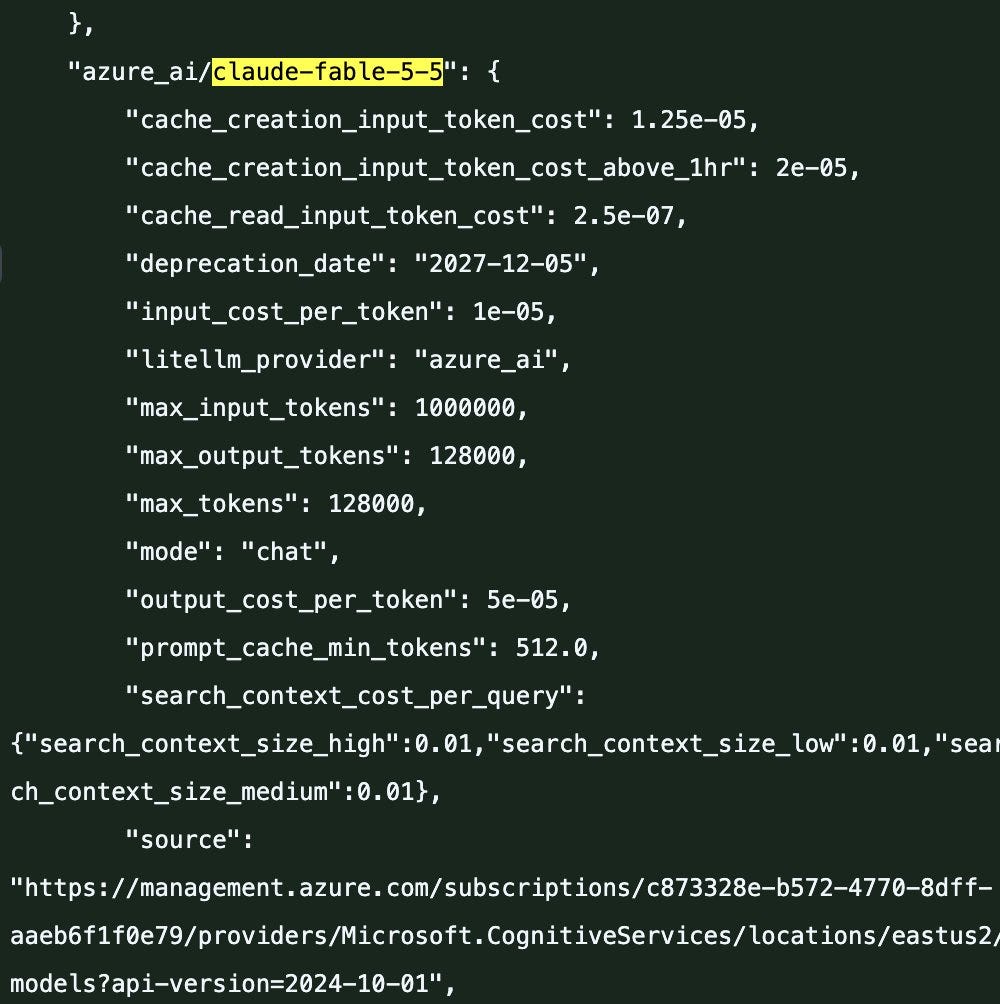
“claude-fable-5-5” showed up in Azure configs, with a LiteLLM entry whose fields look copied from Fable 5.1. No word from Anthropic or Microsoft, so: rumor. And I’m tired of rumors, so let me do one. Anthropic will release Fable 6, then Opus 6, then 6.5, then Opus 7. You heard it here first 😂 We KNOW the models are getting better, I’d rather test them.
Peter completely disagreed (fans told me at AIE they love when we disagree). There’s information in cadence: if Fable 5.5 doesn’t ship for 2 months, that’s news, and with Anthropic going public a launch might move markets. “I’m very pro rumor, but I’m also a psycho, so you don’t have to be.” Wolfram went the other way: a model that’s smart enough AND on your subscription beats a smarter one that burns your tokens.
Live from AI Engineer NYC
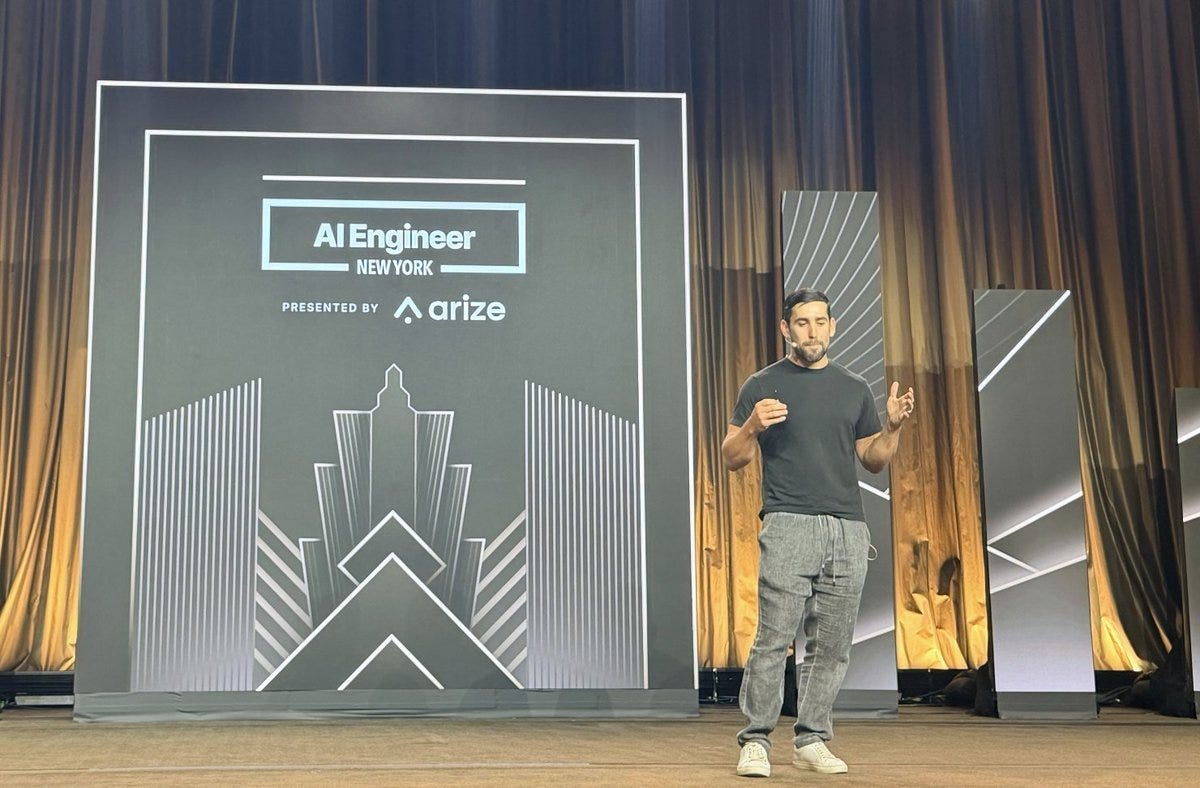
The first time I ever told anyone “I have a podcast” was on my way to AI Engineer in 2023. This New York edition was very New York: Bridgewater, Two Sigma, Citadel, Bloomberg, Capital One, next to OpenAI and Anthropic. Latent Space called the theme autonomy vs security. A year ago the zeitgeist was “agents don’t work”. Now banks say “oh shit, agents do so much work we need guardrails.”
Max Kanat-Alexander (Capital One) - Does code quality even matter? (YouTube)
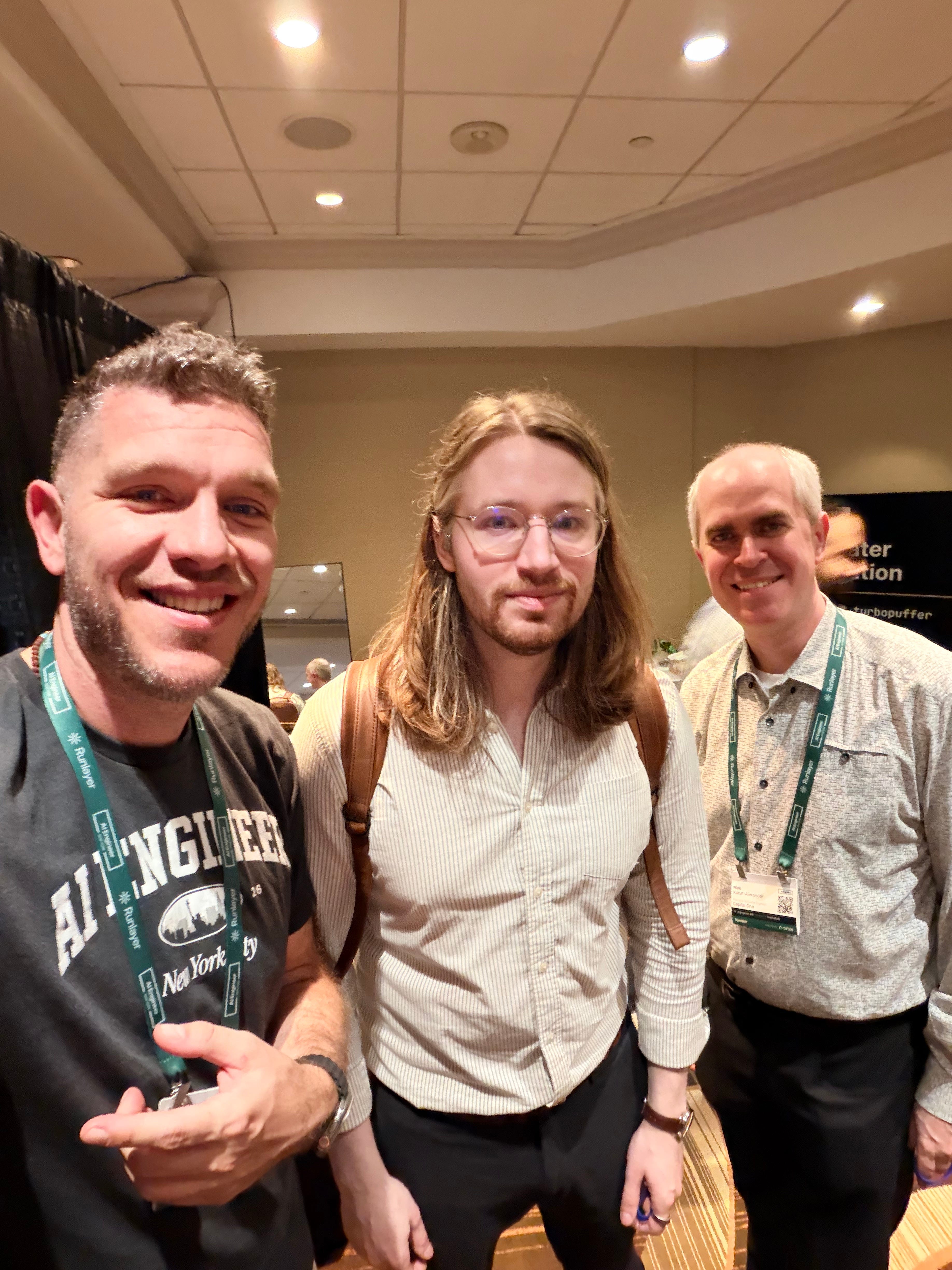
At our CoreWeave “liquid cooling IRL” sauna meetup, I surveyed folks, and many named the same talk: Max Kanat-Alexander, distinguished engineer at Capital One, the “Code Simplicity” guy, ex-Google. His answer: code quality matters in proportion to how durable your software is.
AI is about to make disposable software way more common. A calculator for yourself, a party planner you throw away after the party. Does quality matter if it works? Not really. Durable software needs rigor more than ever, because “the difficulty of understanding does not grow linearly, it compounds over time.” So the job is making rigor cheap. His closer: “Durable software engineering is not going away.”
It fit with Wolfram’s highlight of the week, Linus Torvalds saying refusing AI for code is like refusing a compiler, as long as you understand the code. I’ll admit, I’ve turned my slop cannon at projects where I have no idea what’s under the hood. But a bank’s loan book? Someone needs to understand that.
The zeitgeist: the end of attention
In London the question was “should we still read code?” In New York it’s clear barely anybody does, and the new problem is attention: how do you go from steering 2 agents to running hundreds? Ryan Carson (our old co-host, come back anytime!) says what’s missing is a control plane. The other theme: agents moving to the cloud, because laptops sleep and run out of memory (Peter’s agents literally killed his computer). Also on stage, swyx’s “How to Kill Your SaaS”: 72 weekend clones of a real $43K/year SaaS, about 100B tokens.
And my hot take from the halls: the best AI engineers in the world are sleeping on personal agents. I’d ask “do you use Muse, Grok Bot, any of these?” and mostly hear no. Meanwhile in the Token Billionaires lounge, the non-engineers ALL knew Muse, because Zuck is pushing it on every Instagram post.
PSA: if you listen to this show, you’re good enough to submit a talk to AI Engineer. The speakers lounge is the highest density of AI talent anywhere. Peter’s warning: acceptance rates are low, “don’t just LLM generate your proposal.”
State of AI 2026 with Nathan Benaich (X, Report)

The State of AI report turns 9 this year: 244 slides, a scorecard on last year’s predictions, and 9 new ones, including AGI 2027. Thanks Peter for connecting us!
Nathan says the story of the year is RSI, AI building AI. Claude now guides about 26% of research directions in Anthropic’s core model R&D, up from basically zero. My favorite experiment: a research path forks, a model continues one branch, a human the other, and a human judges. Old models won about 10% of the time, Mythos-class models about 60%. That’s “scientific taste”.
Hits on his scorecard: US labs pushing back into open source, data center NIMBYism (Americans would rather live near a nuclear plant than a data center!), and Chinese labs topping leaderboards. The miss: “AI neutrality” pacts. Peter liked the 50/50 hit rate, it’s easy to “predict” what already happened.
The part I loved: Nathan thinks 90% of people use a model at best for email and never click the “work” button. The labs should open a Genius Bar, a real store that walks people through the magic. The report’s Ramp data shows the gap: about $12 per employee per month on average, about $7,500 for the top 1%. 580x!
His P(doom) is very small, but cybersecurity is “very precarious.” He now thinks you CAN make money on frontier AI, open vs frontier is Android vs iOS, and he answers important emails on Astra High because “why would you take the risk using a shittier system?” 😂 Peter’s PSA: book an hour and scroll it yourself, “don’t ask your agent to read this.”
This Week’s Buzz 🐝
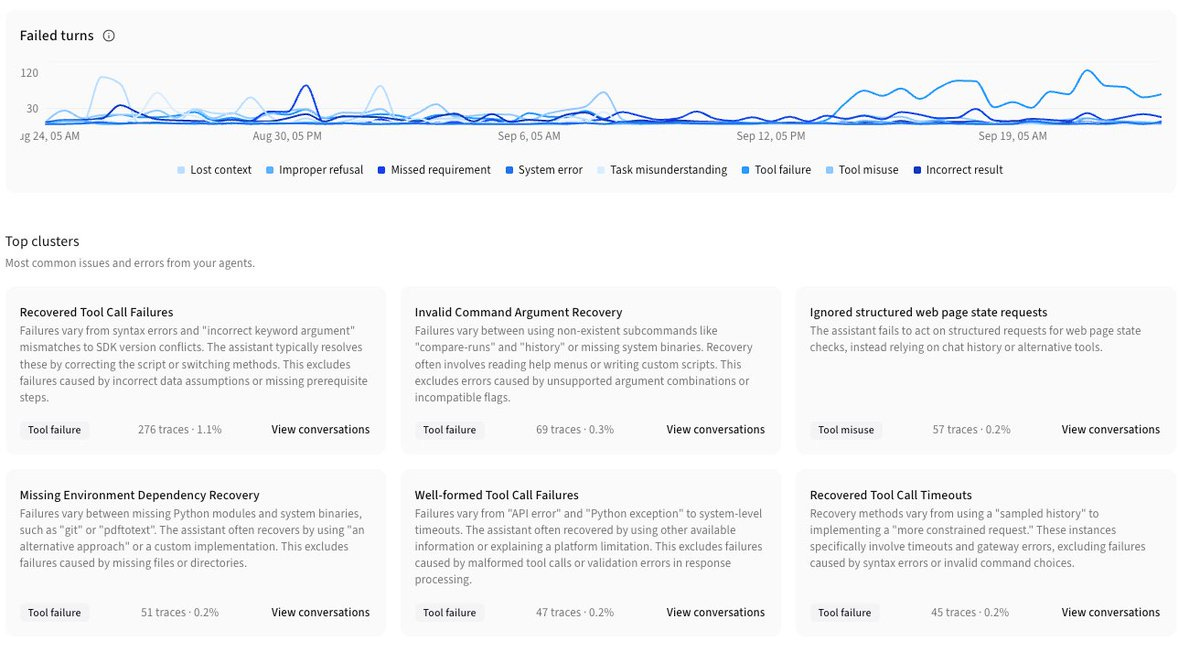
CoreWeave Forge, the new home for W&B, is now a regular SaaS for the first time: no sales call, no long contract, just sign up (Forge).
Agent Lens (preview) is hot this week because Claude Code now speaks OpenTelemetry. Point your Claude traces at it, and it clusters the failures and tells you what to fix, with free LLM judges until Jan 1 (Docs).
Model Distillation (preview): a big teacher with “the best big model smell” (they quoted me 😅) teaches a small open student your one task, built with our friends from OpenPipe (Sign up). And Aria, our agentic research assistant (Karpathy’s auto research as a product), is GA in Forge.
Open source and quick hits
Nemotron 3.5 Super VL - NVIDIA drops a 120B open vision model mid-show (X, Blog, HF)
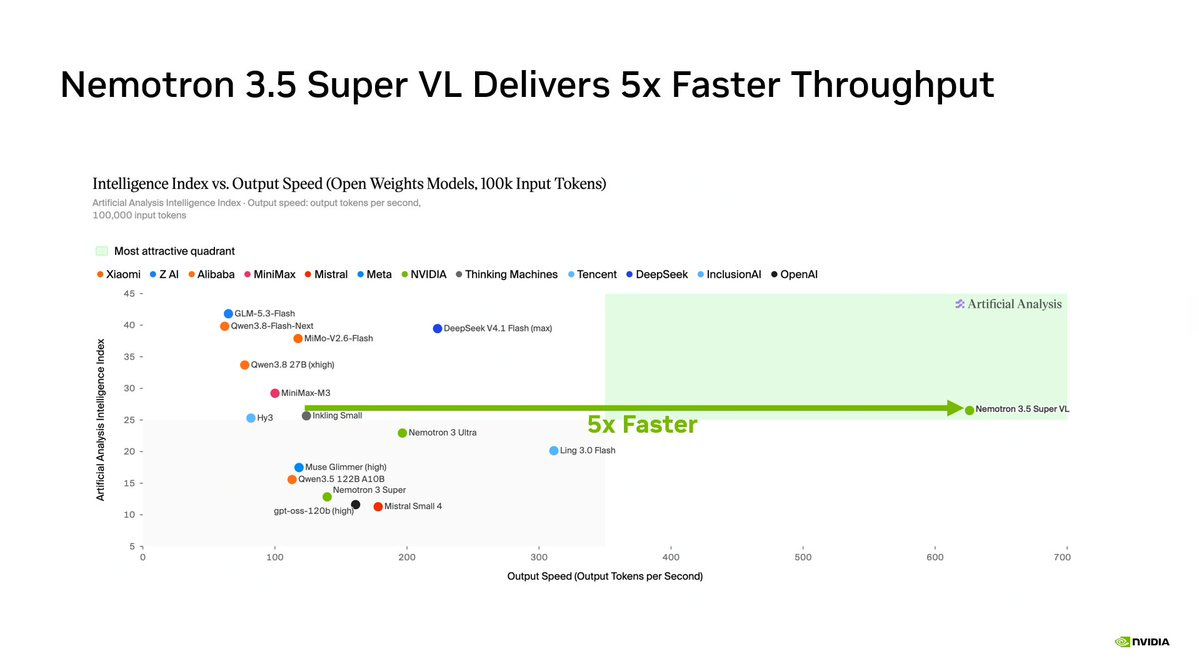
Peter caught it half an hour after it dropped: 120B total, 12B active, images, documents and video, built for long-running agents. Pitched around DeepSeek V4 Flash level but fast, NVIDIA claims up to 5x the throughput of open models its size. Open weights, data and recipes, haven’t tested it yet. Shout out Chris Alexiuk! Rumor alert: NVIDIA is reportedly in talks to buy Reflection. Jensen is collecting the Infinity Stones of open source.
Also open: MiniCPM-V 4.7 runs a 35B vision MoE on an iPhone in about 3GB, Liquid shipped its biggest model yet for local agents (LFM2.5-24B-A2B), plus QwenGyre, Indra and Amos 1, all in the TL;DR.
Jev 1.14 can see! TypeSafe shipped it on 10.14 at 1:14pm (of course), with image input as a preview. I didn’t get to it on the show and I really wanted to. Only a month since Jev came out! (X)
Voice: Grok Voice 3.0 is #1 on Artificial Analysis speech-to-speech, and Wolfram had his agent wire it into his voice app DURING the show. He’s now talking to Amy with Grok’s voice. His pick of the week, Fish Audio’s open Drama 3, lets you direct how a voice sounds. (Grok, Fish Audio)
Karpathy’s funnel: about 6B people have barely touched an LLM (his napkin math), and only a handful touch frontier models inside labs. My reaction: open up the weights and let us touch them! Sorry Andrej, I love you 😅 (X)
Wrapping up
We started the week with Meta becoming a frontier lab and ended it with Meta dropping an 816B open model in our last 10 minutes. Google is back, Anthropic is printing money, NVIDIA keeps feeding open source. But what I’ll remember from New York is the gap: the best AI engineers are building swarms of agents, and most still don’t have a personal one. Mine found this studio and got me coffee. Go get one.
Wolfram’s ask: tell us what you actually implemented from last week’s show, not the news, what you’re USING. Huge thanks to Omar and Geneviève, Nathan, Peter, Wolfram, Nisten, Yam and LDJ, and everyone who came up at AIE to say they listen. That’s what keeps us going. If you haven’t subscribed on YouTube, please do. See you next week 🫡
TL;DR and show notes
Hosts and Guests
Alex Volkov - AI Evangelist, Weights & Biases & CoreWeave (@altryne)
Co-hosts: @WolframRvnwlf, @petergostev, @nisten, @yampeleg, @ldjconfirmed
Omar Sanseviero and Geneviève Huskens, Google DeepMind (@osanseviero, @genevieve__h)
Nathan Benaich, Air Street Capital, State of AI Report (@nathanbenaich)
Big CO LLMs + APIs
Meta Muse Wonder ($4/$20, API) and Muse Wonder Full (Muse Code only), #2 on Arena Text (X, X, Blog)
Gemini 4 Argon GA, #1 on Arena, $2/$10 until Nov 30 then $4/$20 (X, X, Blog)
Argon helped Gemma 4 E2B pass 120K tokens/sec on one A100 in vLLM (X)
Anthropic distillation defenses cut harvested data 90-99% (X, Blog)
Agent SDK, claude -p and third-party apps still use subscription limits; Max and Team get monthly API credits (X, Docs)
Anthropic tells investors Q3 revenue was ~$16.8B, adjusted profitable; IPO reportedly November (X, CNBC)
Rumor: Claude Fable 5.5 spotted in Azure configs, unconfirmed (X)
Microsoft Maia 300 inference chip and Microsoft-Decision-1 (9B, $0.042/M input) (X, X, Blog)
TypeSafe Jev 1.14 with preview image input, a new box type and longer context (X)
Open Source LLMs
Meta Muse Spark Open, 816B/42B active, 1M context, Muse Model License (X, Blog, HF)
NVIDIA Nemotron 3.5 Super VL, 120B/12B active open vision-language model (X, Blog, HF)
OpenBMB MiniCPM-V 4.7, 35B-A3B multimodal MoE on iPhone in 3GB, plus a 1B (X, HF)
Qwen QwenGyre, elastic RL framework for long-horizon agents (paper) (X, Arxiv)
Datalab Indra, 1M-parameter OCR, 49 pages/sec on CPU (X, HF)
Amos 1, four open decision models (0.5B-27B) with bounding boxes (X, amos.scira.ai)
DecisionModels, a hub for the top decision models from the JevBench creator (X)
AI Engineer NYC
This Week’s Buzz
Voice & Audio
Industry & Interviews
Karpathy: ~6B people have barely used LLMs, and the gap is widening (X)
Nathan Benaich on the State of AI Report 2026, 9th edition, 244 slides (X, stateof.ai)
Gemini 4 Argon demos in AI Studio: Desk Racer and more (X, Desk Racer)


