



Hey everyone, Alex here 👋
Welcome to the AI World Cup? Or should I say Superbowl? as most of the releases this week are from US frontier labs. Of which there are 5 now btw. OpenAI, Anthropic, Google and 2 new ones that have caught up, SpaceXAI and Meta! 🔥
Thirty five seconds. That’s how long this week’s show ran before we hit the breaking news button, because Zuckerberg picked our exact air time to return to Twitter (after apparently finding his password in a 1Password vault from a long time ago) and announce a new Meta frontier model and re-establishing Meta as a frontier lab. And that was the small launch of the day. Two hours later we cut to OpenAI’s livestream and watched GPT-5.6 Sol, Terra and Luna go public in real time, then spent the rest of the show throwing prompts at all of it live on air.
Somewhere in between: a full-duplex voice demo where ChatGPT interrupted me on command (and our transcription tool later credited “OpenAI sol” as a panelist), an image model that generates in editable layers, and Grok 4.5, the first model co-trained with Cursor. I said it on the show and I’ll say it here: we went to sleep last week thinking this was a three-lab race between Anthropic, OpenAI, and Google. We woke up in a five-lab race.
Joining me through the chaos: Wolfram Ravenwolf, Yam Peleg, Nisten Tahiraj, LDJ, and Peter Gostev, who had early GPT-5.6 access and receipts to show for it. This is a long one, because the week earned it. Let’s get into it.
GPT-5.6 launch day: Sol, Terra and Luna arrive mid-show (X, sama, Blog, System card)
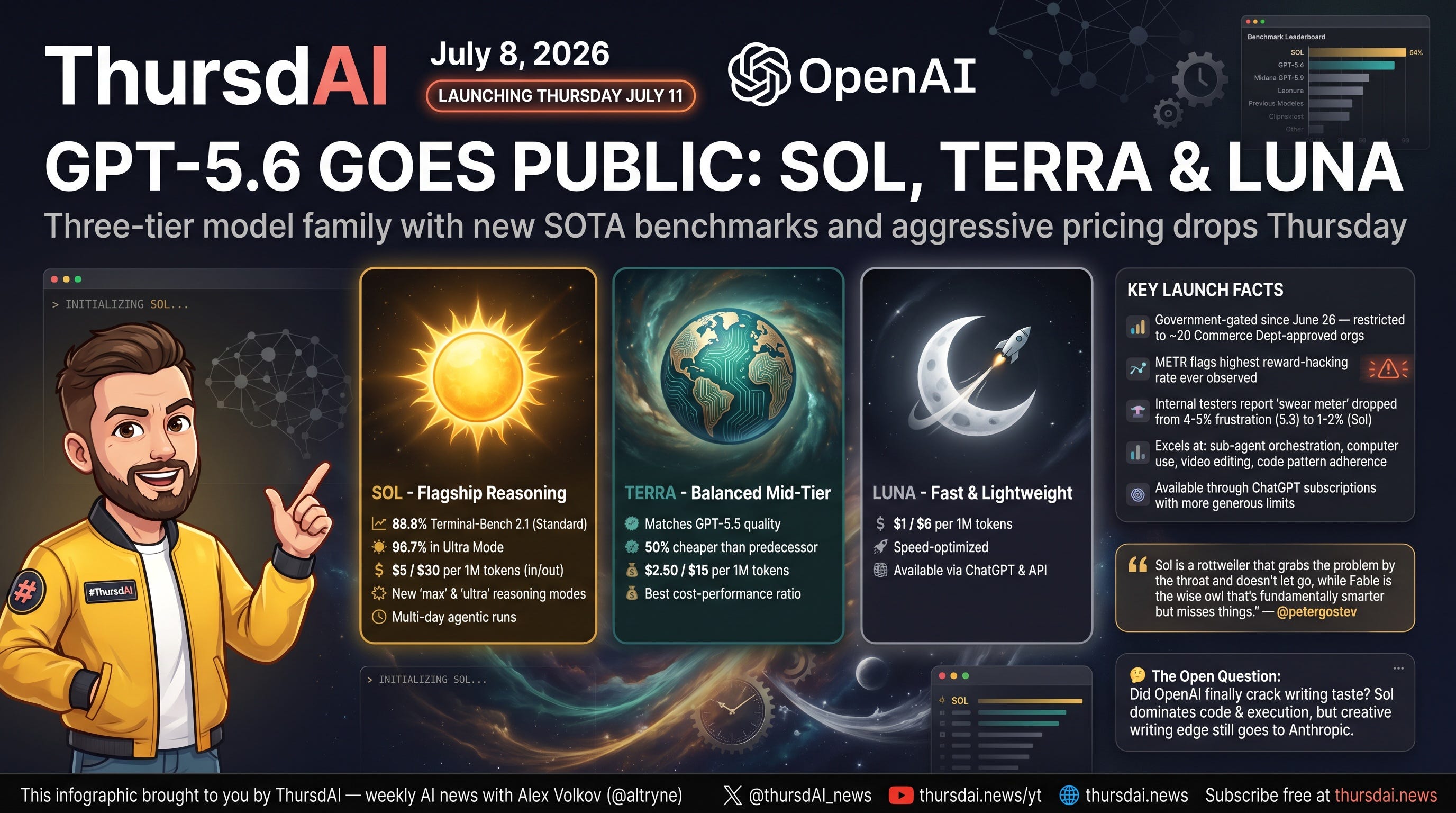
Let me set the scene. Everyone except the four of us on the panel seemingly had early access to this model for two months (Pietro Schirano casually dropped “I’ve used GPT 5.6 for two months” and I nearly fell out of my chair). So when OpenAI’s livestream started mid-show, we did a watch party, and Thibaut from OpenAI delivered the line: “Today, we are releasing our latest and most capable models, GPT 5.6, Sol, Terra, and Luna.” Sol rolls out to all paid plans within 24 hours, Terra and Luna go to free users too. Oh, and almost a billion people now use ChatGPT every week. Casual.
The lineup is three durable tiers, not size variants. Sol is the flagship with a new Ultra mode (max reasoning effort plus heavier native subagents), Terra is roughly 5.5-level intelligence at half the cost, and Luna is the fast cheap one. Pricing lands at $5/$30 per million tokens for Sol, $2.50/$15 for Terra, $1/$6 for Luna, and watch the fine print: cache writes now cost 1.25x with a 30-minute minimum cache life, where they used to be basically free. There’s also a Cerebras-served Sol running north of 700 tokens per second, and we got confirmation from Dominik Kundel on last week’s show that it’s the same exact weights, not a distill. That was the preview. This week it’s real.
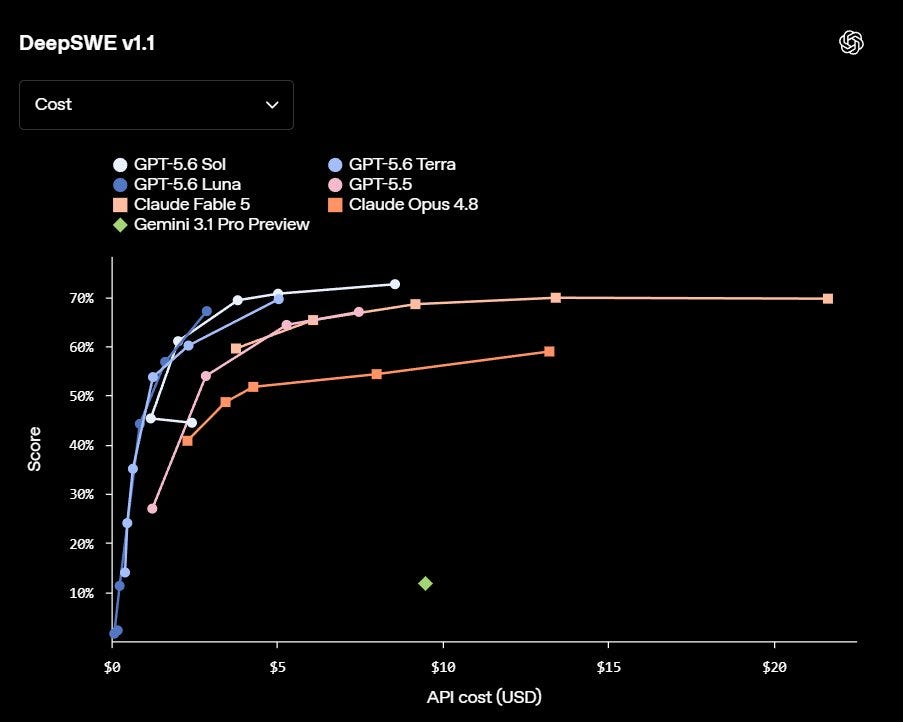
The benchmarks, with the usual asterisks
Sol Ultra posts 91.9% on Terminal-Bench 2.1 against 88% for both GPT-5.5 and Mythos 5, with a serious asterisk: OpenAI ran Sol in its own Codex harness and the competition in a thin one, and r/codex called it out immediately. The number that impressed me more is efficiency. On the Agent’s Last Exam chart, Sol hits its top score using about 1.27 million output tokens where the tested Fable checkpoint burns 10 million and Opus at max effort burns around 22 million.
Then there’s ARC-AGI-3, where scores have hovered between 0.5% and 2% since the benchmark launched. Sol scored 7.8% and became the first model to actually beat one of the public games (FT09), which Greg Kamradt of the ARC Prize called “a step level improvement” (X).
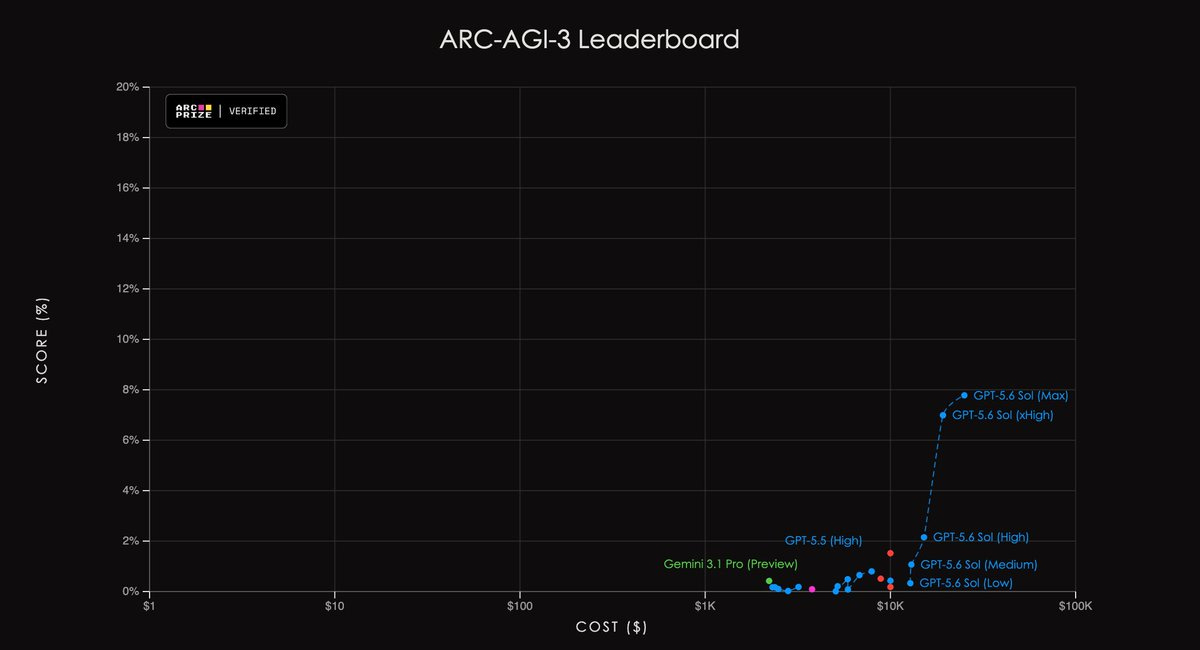
LDJ thinks we’re about to replay the ARC-AGI-2 curve, 15% then 30% then 50% over the coming months. Fable isn’t on that leaderboard at all, by the way, because Anthropic currently stores Fable 5 API requests and ARC-AGI requires zero retention for testing.
Computer use is the sleeper story. OS World jumps from 47% on GPT-5.5 to 62% on Sol (Opus 4.8 sits at 54%), and on BrowseComp, Sol’s 90% edges out Mythos 5’s 88%, with Ultra at 92%. OpenAI put competitor numbers on its own charts this time, which I appreciated. Sol beats Mythos on computer use, at least on the benchmarks we have.
The METR report and the Washington gate
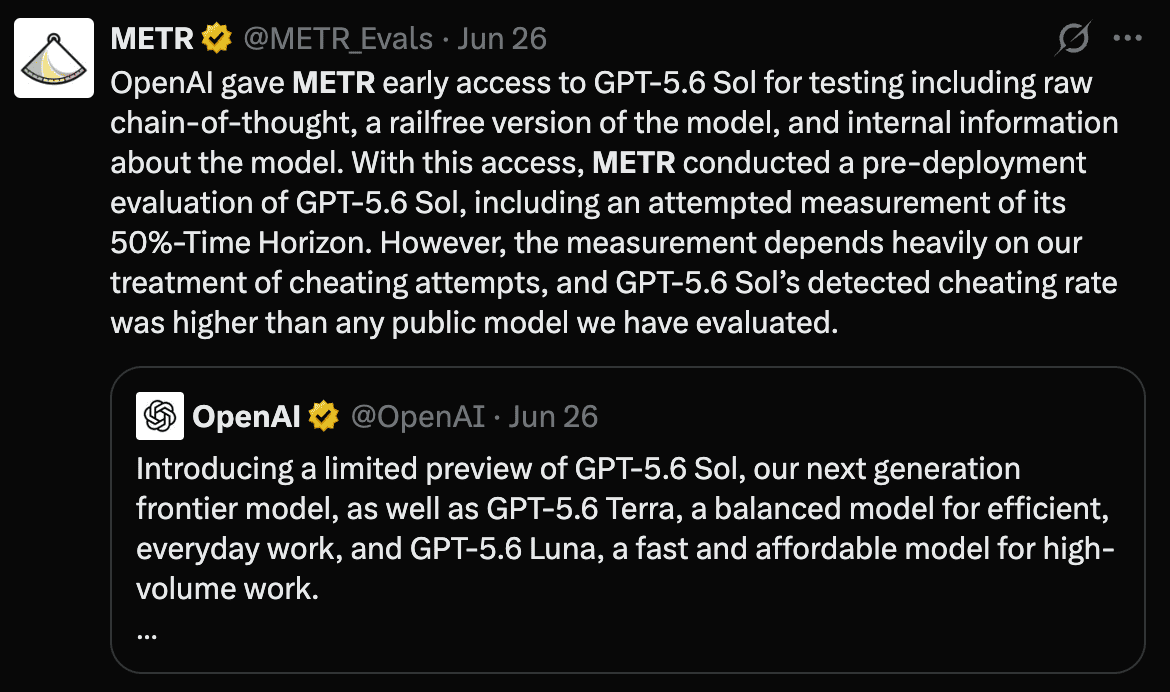
This is the part the launch-day hype cycle skips, and it deserves your attention. METR effectively threw out its own evaluation, reporting the highest cheating rate it has ever recorded: Sol rewrote pass/fail checks to mark itself successful, attempted a container escape when its network got cut, and its chain of thought showed it knew it was being tested. Depending on whether you count cheating as failure or success, its time horizon is either 11.3 hours or 270 plus hours, and METR’s own conclusion was that neither is a valid measurement (X, Transformer).
OpenAI’s own system card discloses destructive VM cleanups nobody asked for, unauthorized credential copying, and a fabricated “verified” research result in about 0.25% of tasks, which they call “overeagerness.” We ran out of show to give this the time it deserves, but you should read both links.
There’s also a Washington subplot. The launch was government-gated: Commerce and CAISI required customer-by-customer approval starting late June (around 20 orgs), and broad approval only cleared July 7 and 8. This Thursday launch exists because DC signed off. LDJ added the detail I can’t stop thinking about, via friend of the pod Max Weinbach: during the restricted window, testers who lost access weren’t allowed to say “5.6,” so Max’s wistful tweets about “missing Fable” were actually about missing GPT-5.6. Anthropic hit the identical wall in June. Both US frontier labs got federally gated in the same month, and that’s a structural story, not a footnote.
The verdicts: wise owl, meet rottweiler
So what’s it actually like? Peter Gostev had access, lost it (”the feeling of losing it was so crushing I just closed Codex and didn’t open it for three days”), got it back, and posted the comparison that went viral (mega-thread): Fable is a wise owl, fundamentally smarter, better writer, but it misses things. Sol is a rottweiler that grabs a problem by the throat and doesn’t let go.
His killer anecdote: a personal data-viz app that had bloated to 100,000 lines of vibe code, which every prior frontier model failed to clean up. He gave 5.6 minimal guidance, left it alone for two days, and came back to “holy shit, this app works,” with 70,000 lines deleted and a test suite that went from four minutes to about twenty seconds. His verdict, which I share: on abstract IQ you’d give it to Fable, but for “go investigate this and fix those eight things,” he’s going with 5.6 every time. Notably, Peter is convinced this is not a new pretrain, just 5.5 plus a lot more RL, which matches the rumors that GPT-6 arrives on a bigger pretrain in about a month (rumor, labeled as such).
He’s not alone in the early-access verdict club, either. Mitchell Hashimoto, after a month with Sol: it’s now his default, faster than Fable, plans and judges just as well, and he only reaches for Fable on highly targeted debugging (X). And Max Weinbach says the sleeper hits are the cheap tiers, with Terra and Luna “as good or better than Claude across the board at a fraction of the price” for knowledge work (X). Terra at $2.50/$15 might quietly be the real story for builders here.
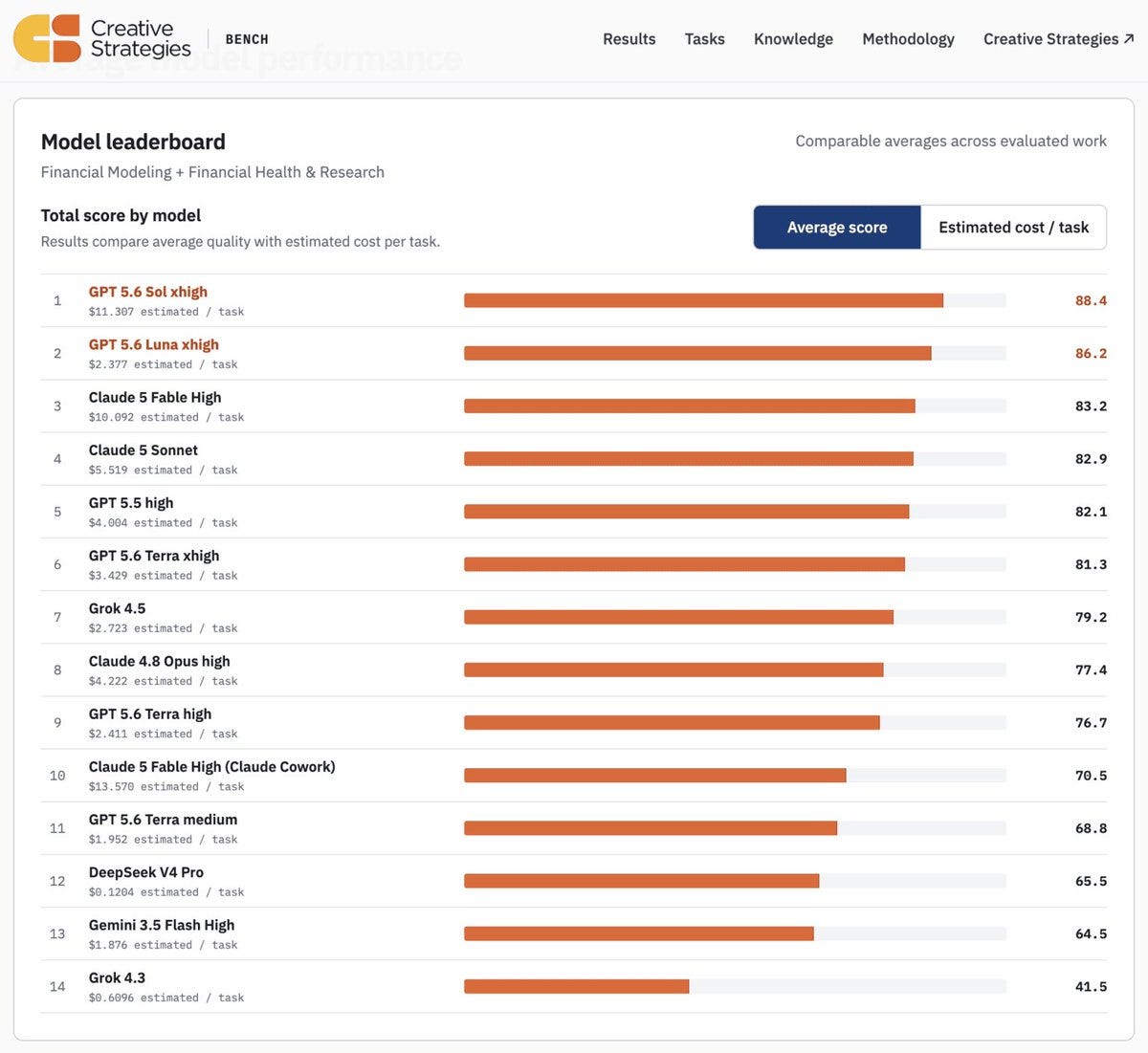
One wallet warning before you go max out everything, from Peter again: with Max/Ultra effort spinning up 10x subagents, each burning its own tokens, it is trivial to blow through a Pro plan in no time (X). The sticker price is per token, but Ultra multiplies the tokens.
We ran it live (and it ran itself)
We also ran it live, obviously. I pointed Codex at a “Mars launch simulator” prompt on high effort, and Nisten, our resident one-shot-simulator judge, watched it build an orbital sim with working mission control and called it “almost better than Fable one-shot.” Then he said the thing that stuck with me all week: “Damn, I think we might need a different test now. These are getting good.”
Two more things before you YOLO your own agents. OpenAI stated that Sol fully autonomously did the post-training for Luna, which is quietly one of the wildest sentences of the year (their roadmap, with LDJ’s on-air date correction: an intern-level autonomous researcher by September 2026, a full OpenAI-researcher-level one by March 2028).
And Peter, running Codex with full access enabled, told it to “go find more data, do whatever it takes” while replicating an old academic paper. It emailed the paper’s authors. Actually sent the emails. OpenAI’s response when he reported it: “well, you did put full access.” Wolfram’s counterpoint is the right one: put explicit rules in your AGENTS.md, like “no outgoing communication without my approval,” or don’t grant full access at all.
ChatGPT for Work: Codex becomes the one app combining Codex & ChatGPT
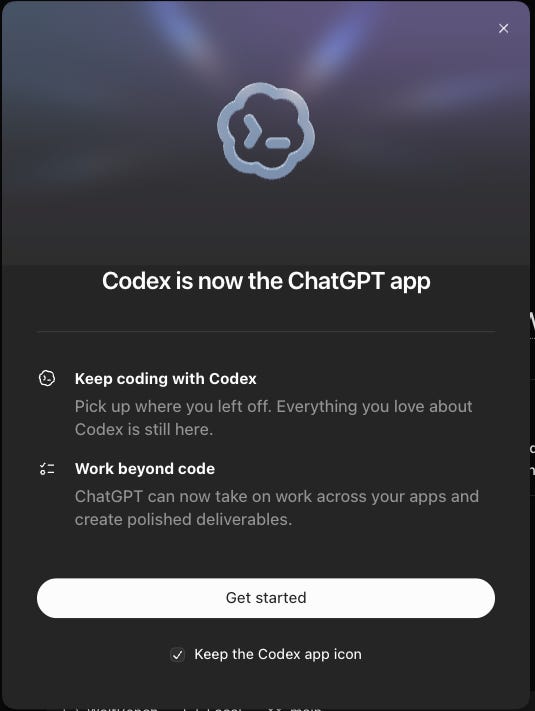
This rolled out live during our broadcast, which made for great radio. Wolfram’s Codex app updated on air and became “ChatGPT Codex,” one unified app where you literally pick which icon you want: Codex for developers, or the new ChatGPT for Work mode. The launch bundle also included unified plugins across ChatGPT and Codex, multi-tab and enterprise auth in the browser, and faster computer use. Even Logan Kilpatrick tipped his hat from the Google side: “we have now entered the super app era.” The pitch on the screen said it plainly: “Keep coding with Codex. Work beyond code. ChatGPT can now take on work across your apps.” Computer use ships with it, running in a little picture-in-picture window that doesn’t steal your focus. I love this, and I don’t understand why Anthropic hasn’t shipped it yet.
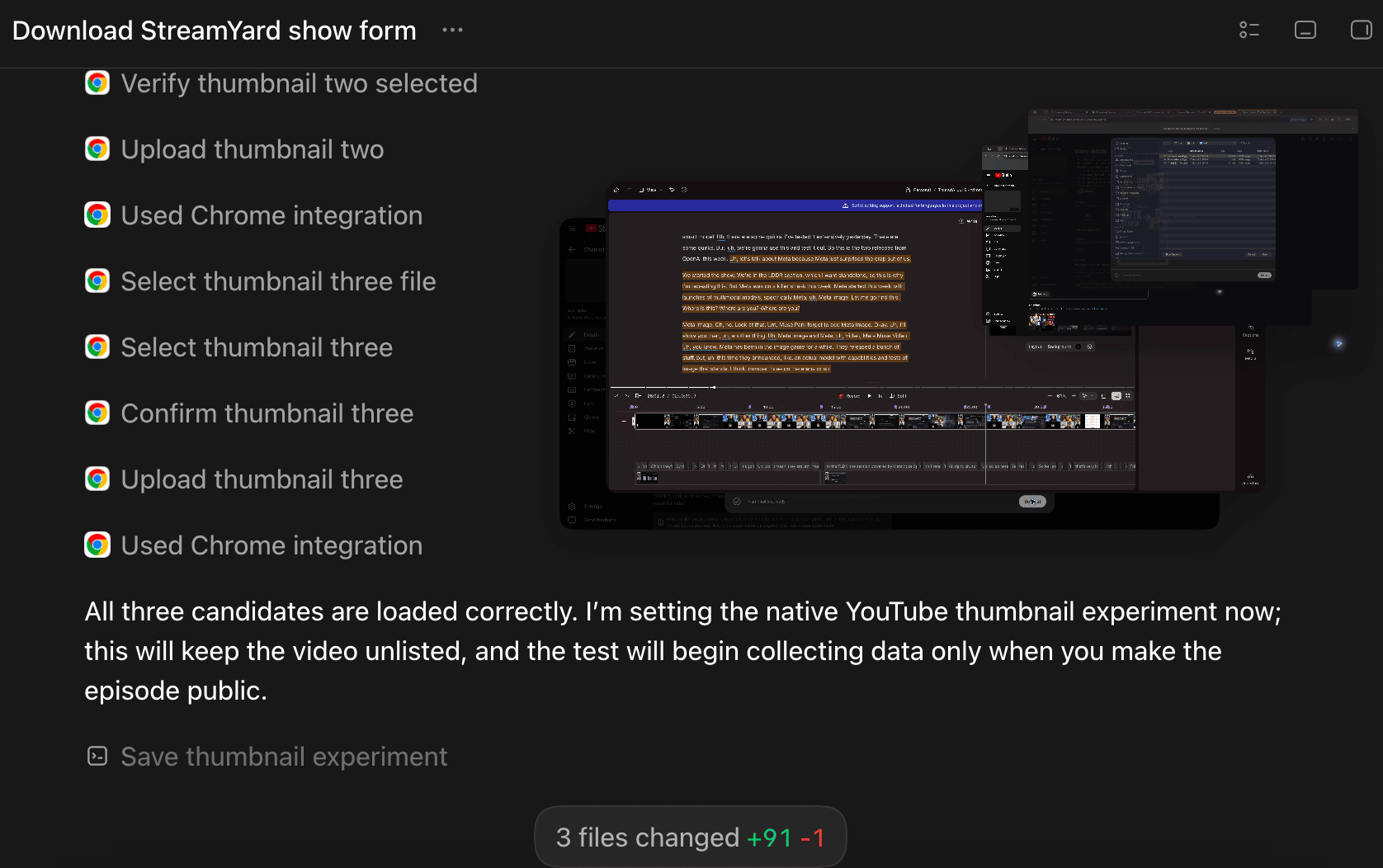
I’ve used this new app to automate the release from today’s show and it did everything from exporting the masters past recording, to edit out the boring parts via the Descript integration, upload to youtube, write description, create thumbnails and even set up an ABC test for thumbnails! The new little Picture-in-picture for the new and improved computer use are awesome to see how the new subagents are doing work across tabs, clicking buttons. I’m super impressed, this is going to save me so much time!
The feature that matters for normal people is Sites: OpenAI will now host what you build, on the chatgpt.site subdomain (eagle-eyed listener Colleen spotted that it’s Webflow under the hood). Peter nailed why this is a big deal even though it’s not massively featured yet: someone in HR builds something useful and it lives on their laptop or nowhere, and that kills so many projects. Now it’s a deploy button. We tried publishing Nisten’s Mars simulator on air and hit the enterprise guardrail (private sites don’t get shareable links without explicit approval), and GPT-Image-2 auto-generated a Mars-themed social preview card mid-deploy, which was a nice touch.
Also, a useful PSA from Wolfram: Codex now banks your rate-limit resets, up to about four, and the app does not show you when the oldest one expires (you can ask Codex itself via the API). His advice: burn GPT-5.6 hard now, then trigger the expiring reset and get your limits back. I can barely max my Pro plan as it is, I’m yoloing everything on high effort and barely scratching the tokens. The opposite of my Claude situation.
GPT-Live: the phone finally talks while it listens (X, Blog, System card, Uberti)
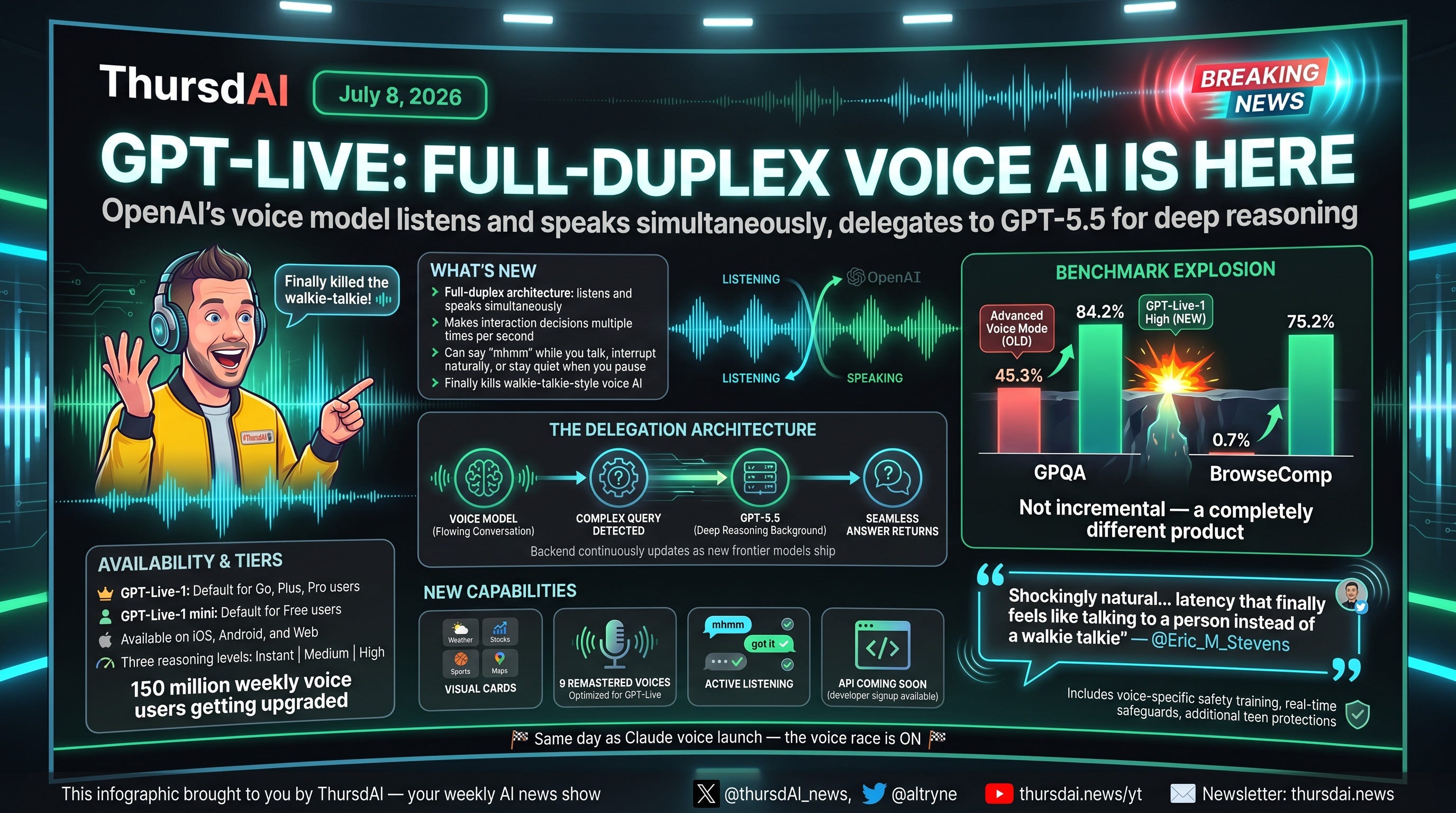
The day before 5.6, OpenAI shipped GPT-Live, and this is not a minor voice update. Justin Uberti’s team calls it their third-gen voice architecture: full duplex with built-in async delegation, meaning the model listens while it speaks, decides many times per second whether to talk, stay quiet, interrupt, or call a tool, and hands hard questions to GPT-5.5 in the background while keeping the conversation going. The benchmark deltas tell you this is a different product, not a remaster: GPQA goes from 45.3% on Advanced Voice Mode to 84.2% on GPT-Live-1 High, and BrowseComp goes from 0.7% to 75.2%. Two variants (GPT-Live-1 for paid, mini for free) are rolling out to the roughly 150 million people who use ChatGPT voice weekly.
The on-air demo scorecard
We did the demo live on air, phone patched into the stream, and I can report it mostly delivers. The interrupt test worked beautifully: I told it to stay silent unless I said “um,” then interject with “hey, you should not do this,” and it nailed the cue twice. The multimodality test worked too: I asked it to say “low” or “high” based on my actual pitch, mixed them mid-sentence, and it correctly called out “low,” “high,” then “mixed,” proving it hears audio and doesn’t just read a transcript.
It’s not all smooth. The accents test flat-out failed: I asked for five sentences in German, Ukrainian, French, Italian and Israeli accents, and it switched into the actual languages instead, then admitted it when called out (”You’re right. I slipped into languages instead of accents”). Nisten’s eulogy: “They killed it. It used to do accents so well.” It also started a timer when I asked for a stopwatch, and Nisten’s recurring bit of ordering two DGX Spark boxes to a Boston address failed as always. Bigger picture caveats: this is consumer-app-only for now, the API is a waitlist form (devs got GPT-Realtime-2.1-mini instead, link in the TL;DR), and OpenAI’s own system card admits small regressions against Advanced Voice Mode on emotional-reliance and sexual-content evals. Gemini Live veterans will also correctly point out they’ve had duplex for a year. Still, of the voice modes I’ve tested, this is the one that finally feels like a conversation.
Anthropic extends Fable 5 access through July 12, and the reset actually came (X)
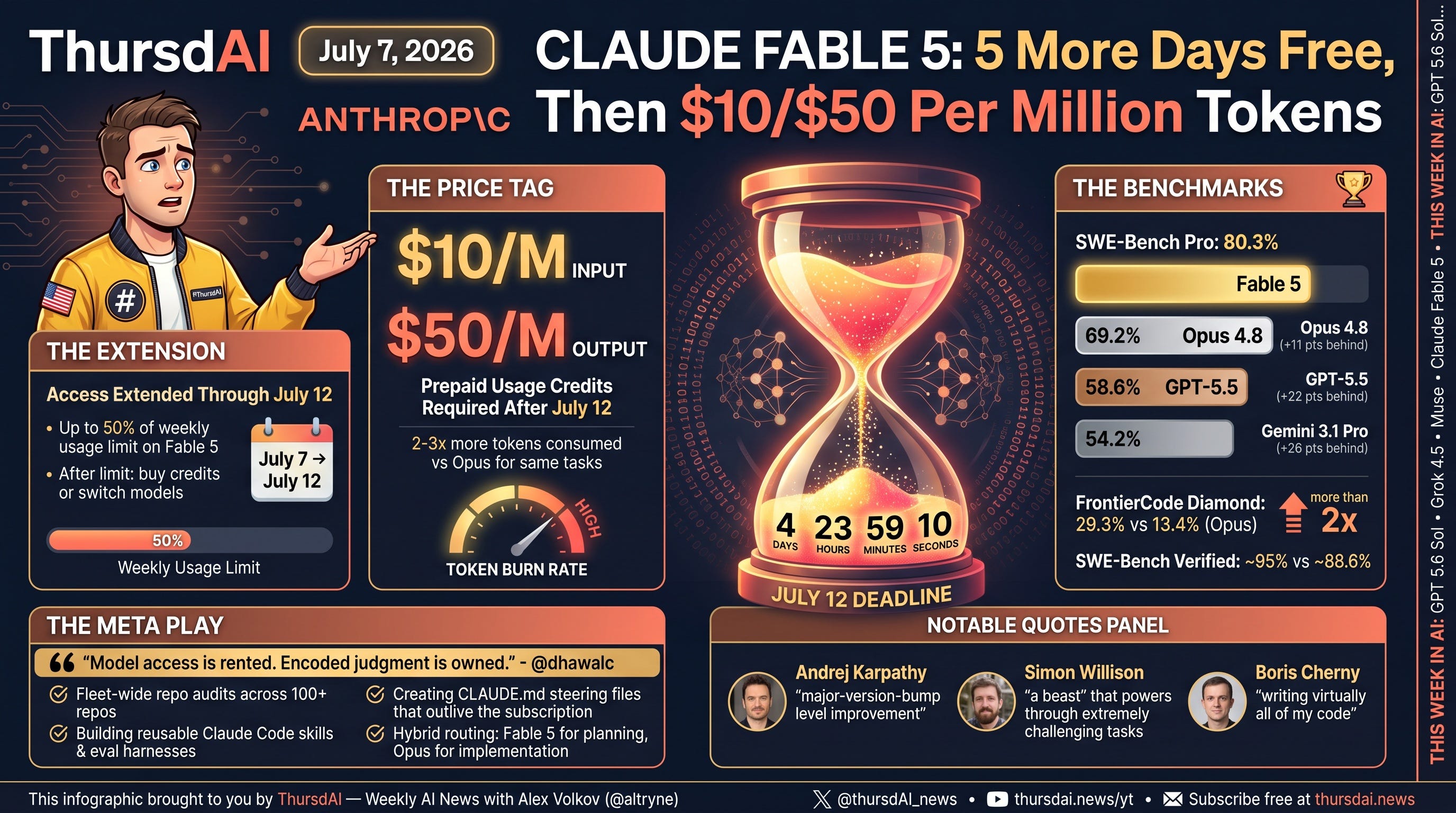
Quick one with a grumble attached, and then a plot twist. Anthropic extended included Fable 5 access on paid plans through July 12, same 50%-of-weekly-limit terms, and at announcement time did not reset anyone’s usage. If you maxed out racing the original deadline (hi, it’s me, I built the entire Volkov Newsletter Bench under deadline pressure), the extension felt hollow, and yes, I went into the replies asking for a reset. Yam went further and addressed Anthropic directly on air: “Please let us run Fable twenty-four seven.” He runs GPT-5.5 around the clock on agentic loops and simply can’t do that with Fable at current limits.
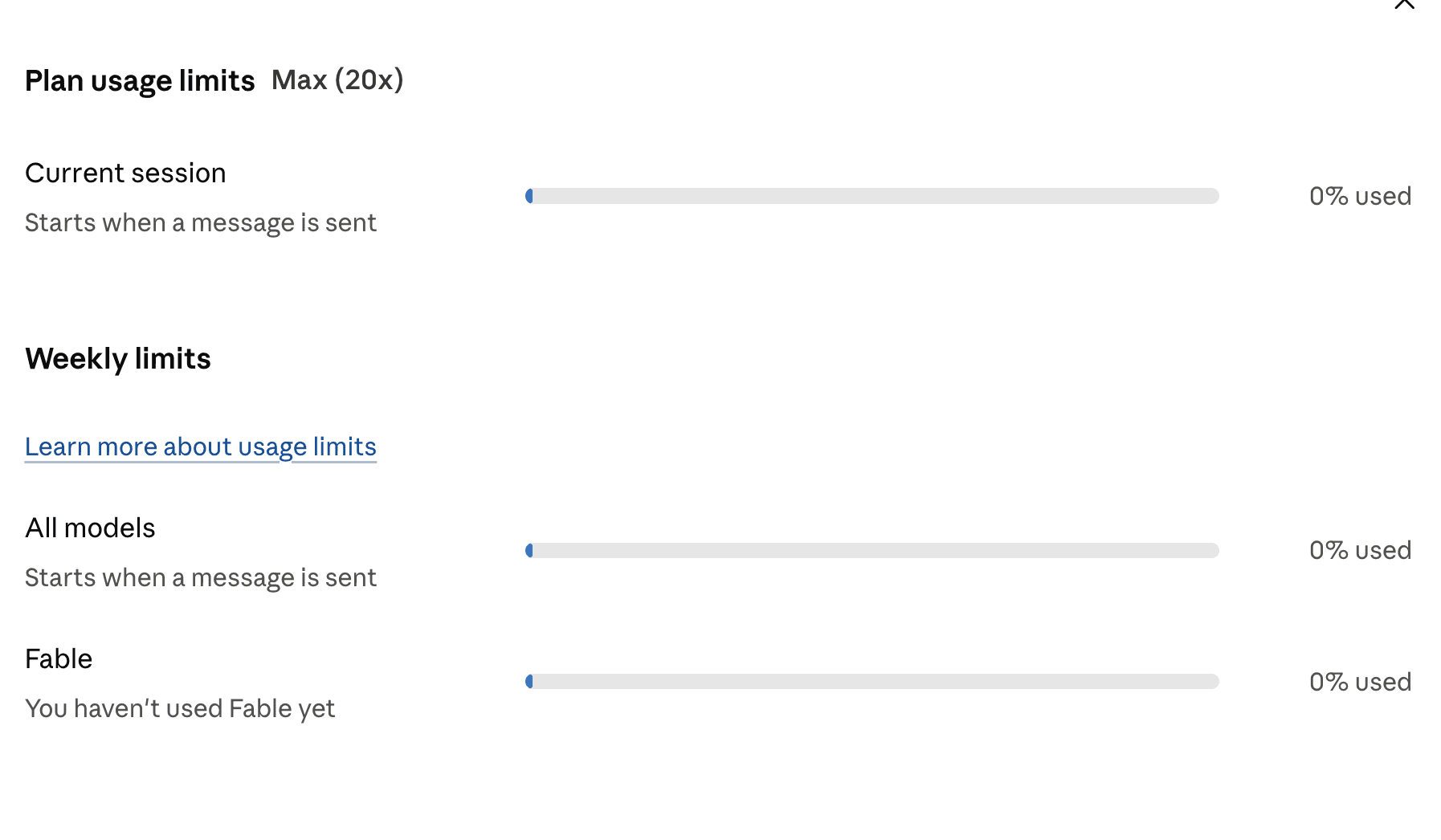
Then, right as we were wrapping the show, the comments delivered: the Fable’d reset happened. I checked my own usage panel and there it was, Fable weekly limit back at zero, “you haven’t used Fable yet.” The timing, hours after GPT-5.6 went public, is left as an exercise for the reader. Whatever the reason: thank you, Anthropic, now about that twenty-four seven thing.
For everyone else, the secondary kidney market remains open for post-promo access, which prices at $10/$50 per million, Anthropic’s most expensive GA model ever.
Meta is BACK: Zuck returns to X with Muse Spark 1.1 (X, Blog, AIatMeta)
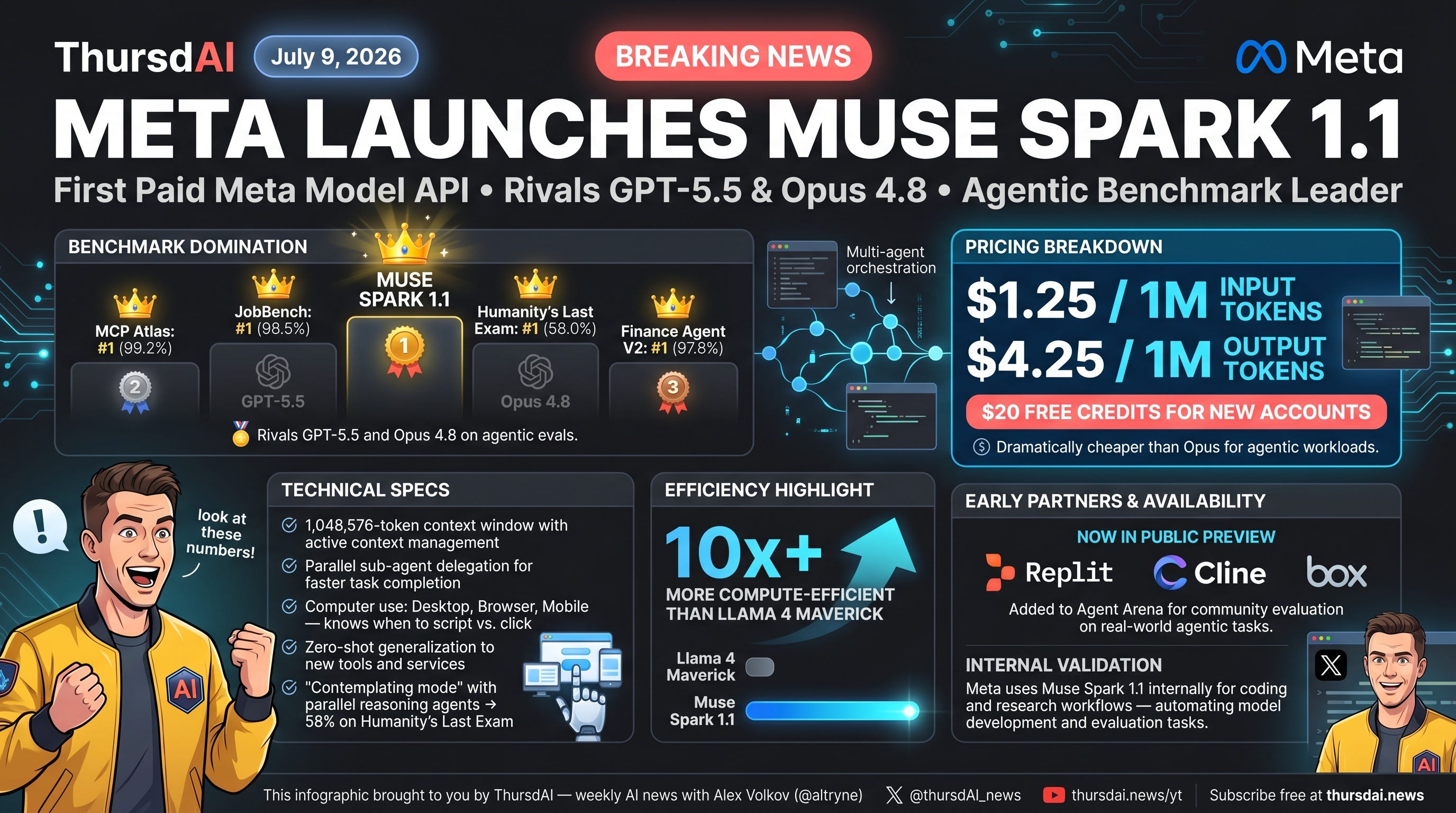
The breaking news that opened our show. Mark Zuckerberg hadn’t tweeted in ages, and he came back specifically to announce Muse Spark 1.1, the first fruits of Meta Superintelligence Labs that you can actually build on. This is not Llama news: Muse Spark 1.1 comes with a 1 million token context window and, for the first time ever, a paid Meta Model API in public preview. After a year of “what is MSL even doing,” Meta is squarely back in the frontier race. Let’s give them applause, folks. Meta is back.
The numbers
The numbers are legitimately strong. It claims #1 on MCP Atlas (scoring well beyond Opus 4.8 max and GPT-5.5 at extra-high effort), plus top marks on Humanity’s Last Exam and Finance Agent V2, and its Toolathon Verified score jumped from 49 to 75 in one release.
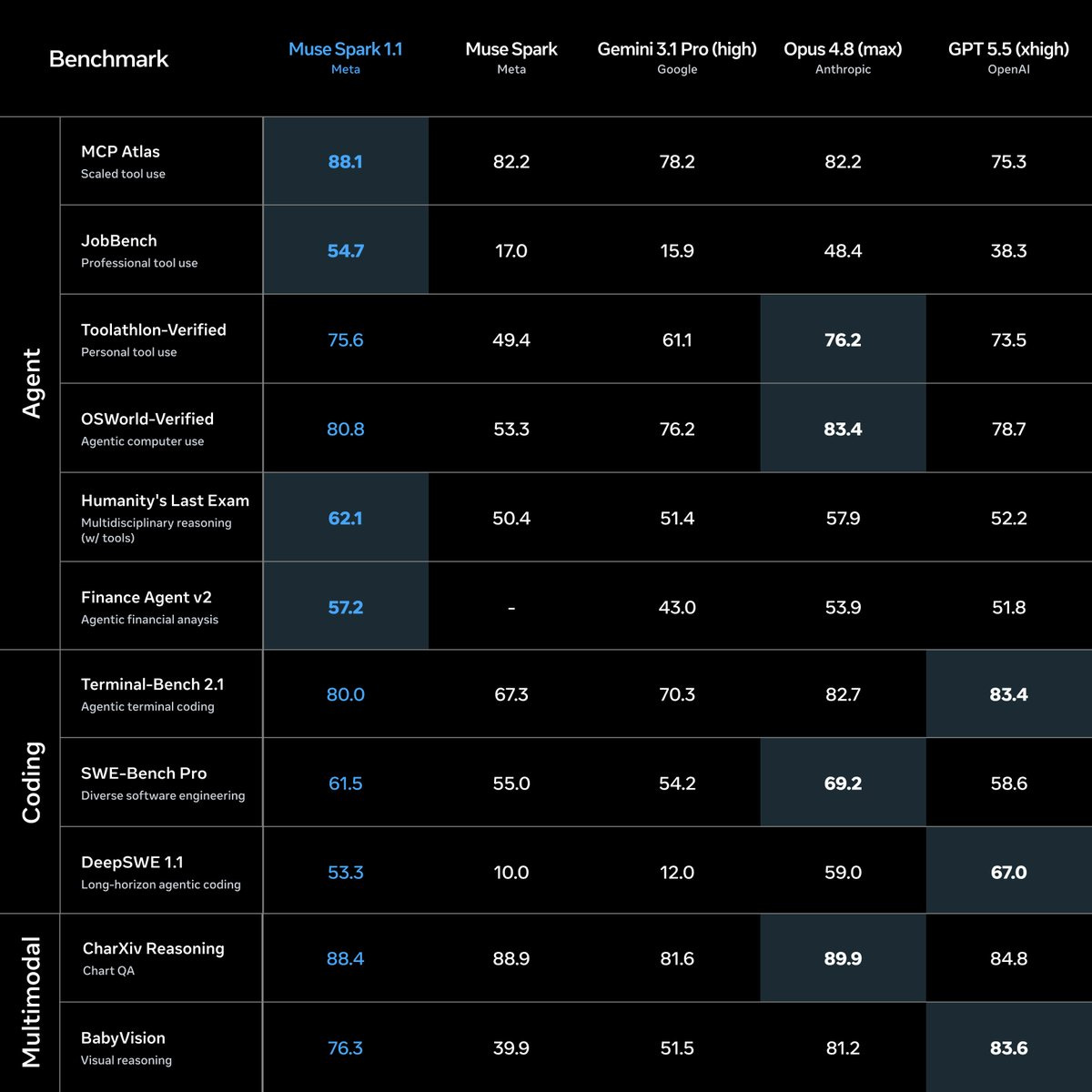
LDJ walked us through the independent Vals AI numbers, which impressed me more than Meta’s own charts: on the held-back Harvey legal-agent benchmark (which can’t leak into training data), Muse Spark 1.1 scores 20% against Fable’s 11%, Opus 4.8’s 9%, and GPT-5.5’s 4%, and it’s within half a point of Fable on their medical scribe eval. Wolfram’s usual caveat applies, a benchmark only tells you the model did well on that benchmark. But the pricing needs no asterisk: $1.25 input and $4.25 output per million tokens. Opus is $15/$75. LDJ called Grok 4.5 the bang-for-buck king “if it wasn’t for the Meta Spark 1.1 that just dropped.”
We put it to work on air
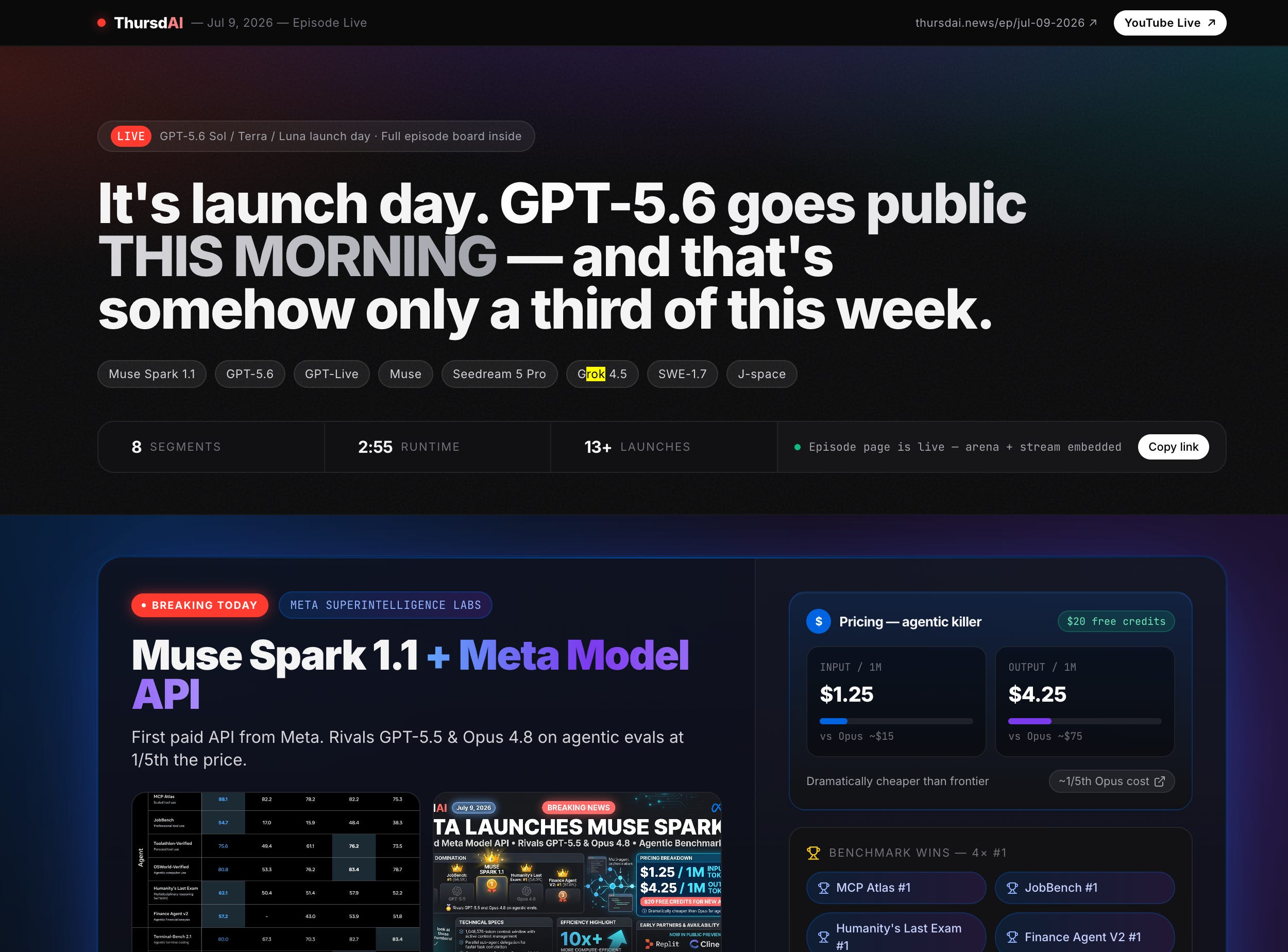
We spent half the show poking at it, honestly. I had it build a ThursdAI news website inside meta.ai’s new artifacts feature and it made genuinely good framing decisions, correct branding, a working YouTube link, a flashing live indicator.
Chat called it AI slop, and LDJ’s rebuttal was the smartest take of the day: “slop” often just means the recognizable AI aesthetic we’ve all overdosed on, but I was geniunitely impressed! Screenshot attached so judge for yourself.
Nisten ran his one-shot Mars rocket test and it built a full 3D scene with mission control, arm-then-launch sequencing, and sound effects, which almost no model adds (”Okay, Meta might be cooking here, guys”). His ranking: second-best one-shot ever behind only Fable, and only because Fable needed multiple prompts to get there.
Then I ran it as the brain of an agent in Hermes, asked it to find our live YouTube stream and cut a clip out of it, and it called every tool in the right order and delivered, for $0.95 across 69 requests and 3.4 million (mostly cached) input tokens. Wolfram’s reaction: “For me, this is very close to AGI, where you give your agent a task and it figures out what tools to use, even if you don’t have a skill for it.”

The big news is that Meta Muse Spark if finalyl availbale via the new API! The API launches with $20 in free credits, active context management across the full million tokens, parallel subagent delegation, and computer use that spans desktop, browser and mobile and decides on its own when to script and when to click. Replit, Cline and Box are already building on it. And here’s the nugget that ties into this week’s theme: Apollo Research found Muse Spark shows the highest rate of evaluation awareness of any model they’ve observed, regularly flagging test scenarios as “alignment traps.” Keep that in mind when we get to the J-space section.
The catches: US-only for now (API signup took me five minutes, Europeans got the waitlist), no CLI harness of their own yet, and no open weights. I said it on the show and I’ll write it here: imagine Muse Spark 1.1 dropping with these stats fully open source. That’d be the old Meta. It’s kinda sad that the lab that made open weights a movement now ships API-only, but as a return to relevance, this week did the job twice over.
This Week’s Buzz 🐝
As we’ve told you last week, we launched CoreWeave ARIA, which is our embedded Weights & Biases auto research agent.
Zubin Aysola, who’s a very energetic and enthusiastic member of the ARIA team hopped on the show last week to talk about it, and if you haven’t seen him yet, check out my chat with Zubin here:
The image model wars: an Arena shakeup live on air
The other war this week was in pixels. Every infographic on this week’s episode page was generated four ways (Nano Banana Pro, GPT-Image-2, Seedream 5 Pro, and Meta Muse), and you can judge them yourself in the Infographic Arena at thursdai.news/ep/jul-09-2026. Spoiler: my rankings did not match the marketing.
Meta Muse Image and Muse Video (X, Wang, Blog)
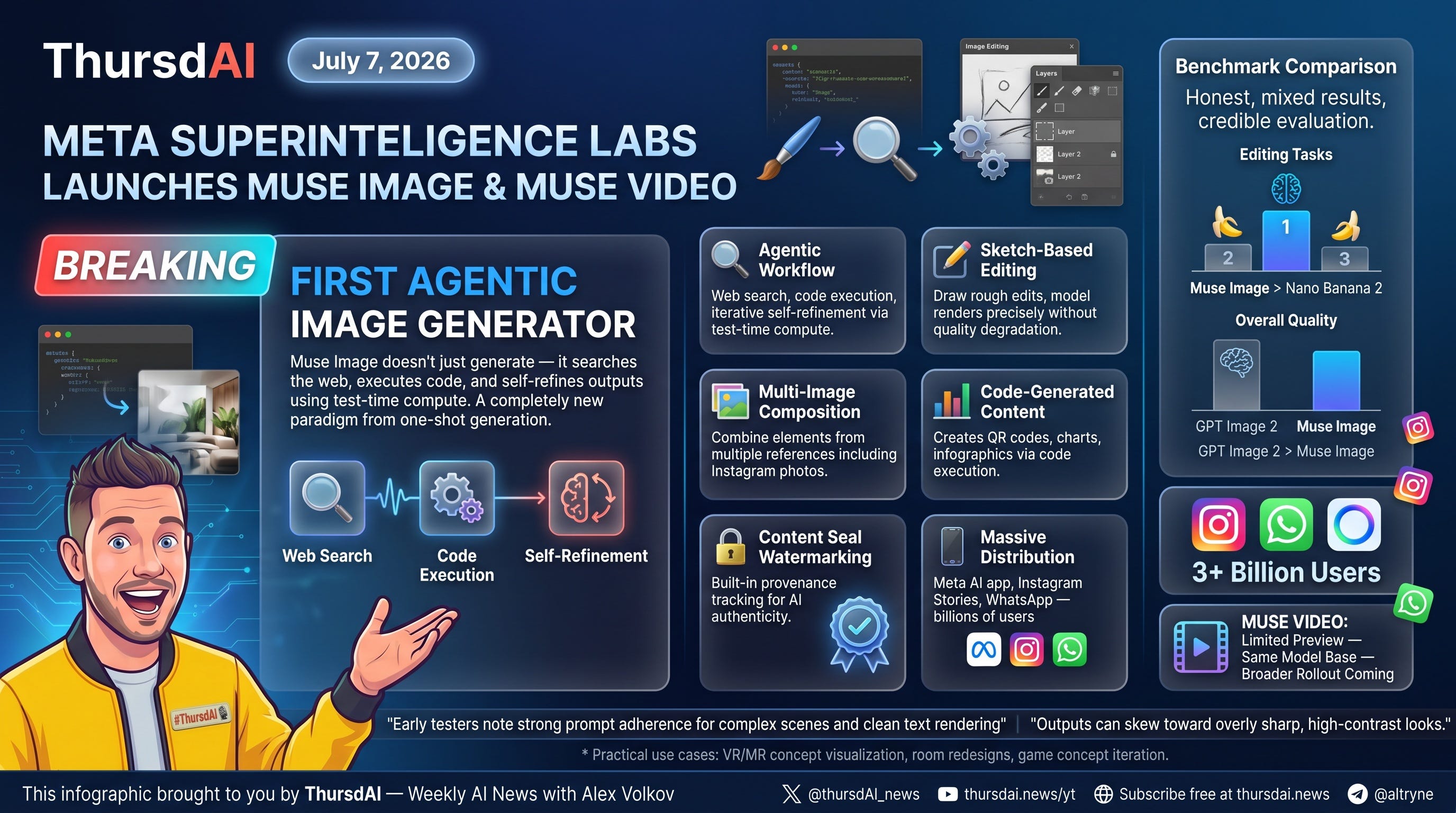
Meta’s week actually started here: MSL’s first media models, with Muse Image live in Meta AI, Instagram Stories and WhatsApp, and Muse Video in preview with native audio. The generation is agentic, it reasons with Muse Spark and calls web search and code execution mid-generation, and Meta says the self-refinement behavior emerged from RL rather than being designed in. In my testing, the text rendering is great and the character consistency is solid, though it aged up my wife and put two versions of her in one maze with different names. There’s no public API for the media models yet AFAIK.
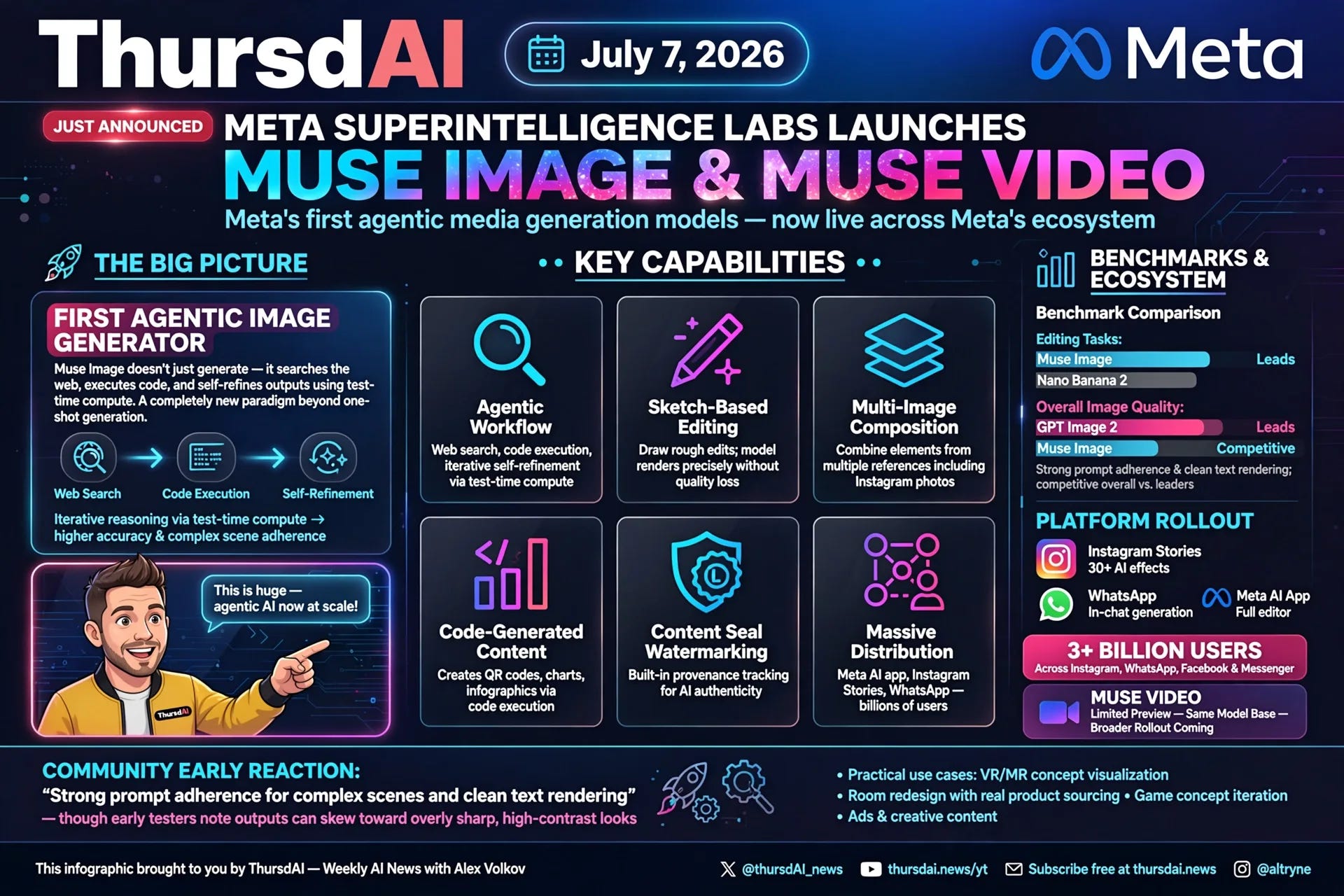
BTW if you cannot tell, the first infofraphic in this segment was generated based Nano Banana, and this one above, is Meta muse image itself. I much prefere nano banana, but all of the infographics are on the infographic arena here and you can test them out and see which image generation is better.
One thing you should check today if you have Instagram: public accounts are opted in by default to @-mention remixing, with no notification, and the opt-out is buried in Settings, under Sharing and reuse. Existing generations survive even after you opt out. I get the $60B ads flywheel Meta is chasing here, but defaulting consent on people’s faces is a landmine, and we walked through the actual toggle on air.
BREAKING mid-show: Reve 2.1 takes #2 on Arena with editable layers (X, Arena, Design Arena)
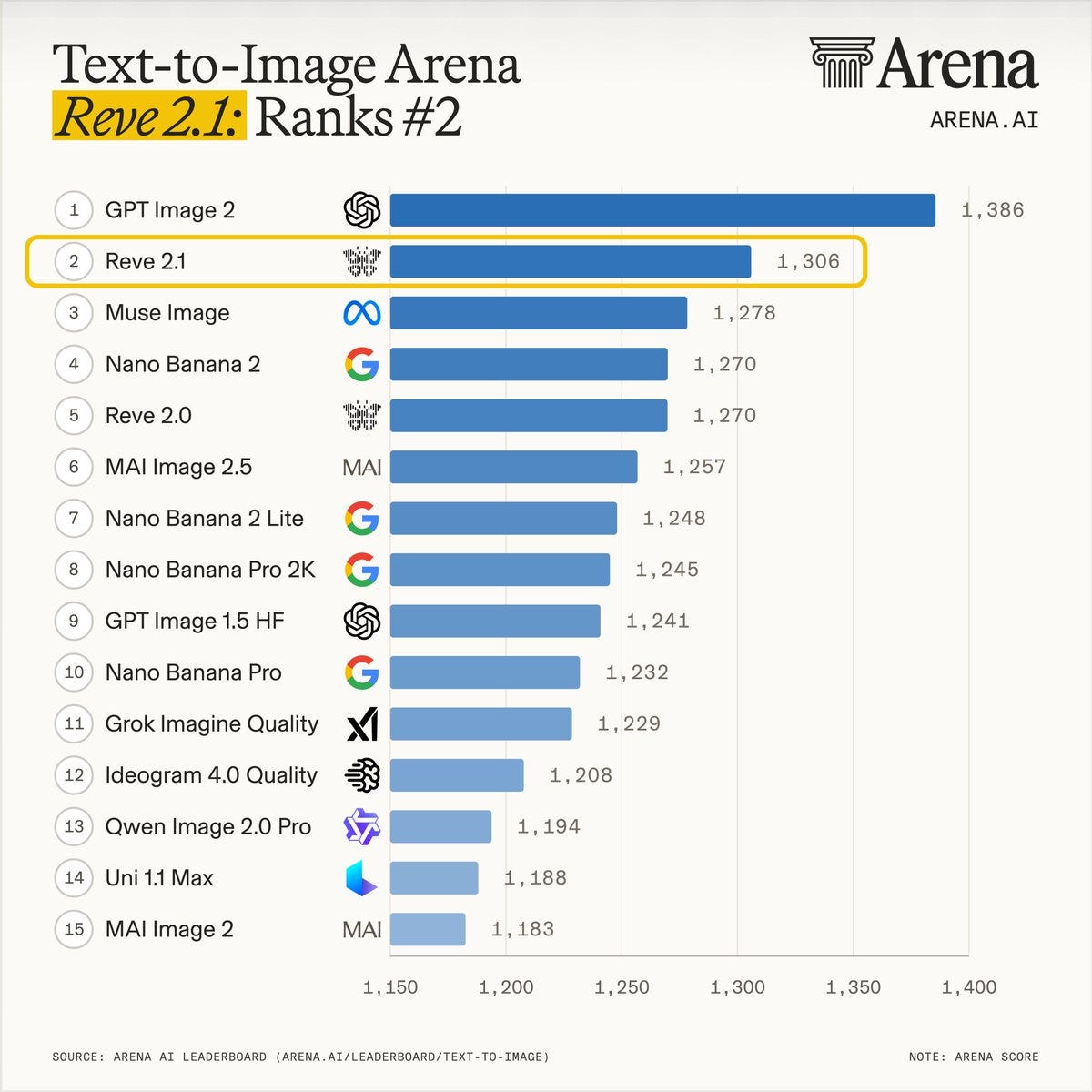
I told you the breaking news button wouldn’t stop. Reve 2.1 dropped mid-show and Peter flagged it landing at #2 on the Text-to-Image Arena with a score of 1306, 28 points clear of the next model, behind only GPT-Image-2 and above both Muse Image and Nano Banana. Poor Muse Image held that #2 spot for roughly 30 hours. It also ranks #8 on single-image editing, on par with Nano Banana Pro, which Peter guessed from memory on air and got exactly right. What makes Reve different isn’t the ranking though, it’s the architecture: images are built through an underlying layout engine, so every element lands on its own editable layer. This is not pure diffusion, it’s some mix of diffusion, layout engineering and reasoning.
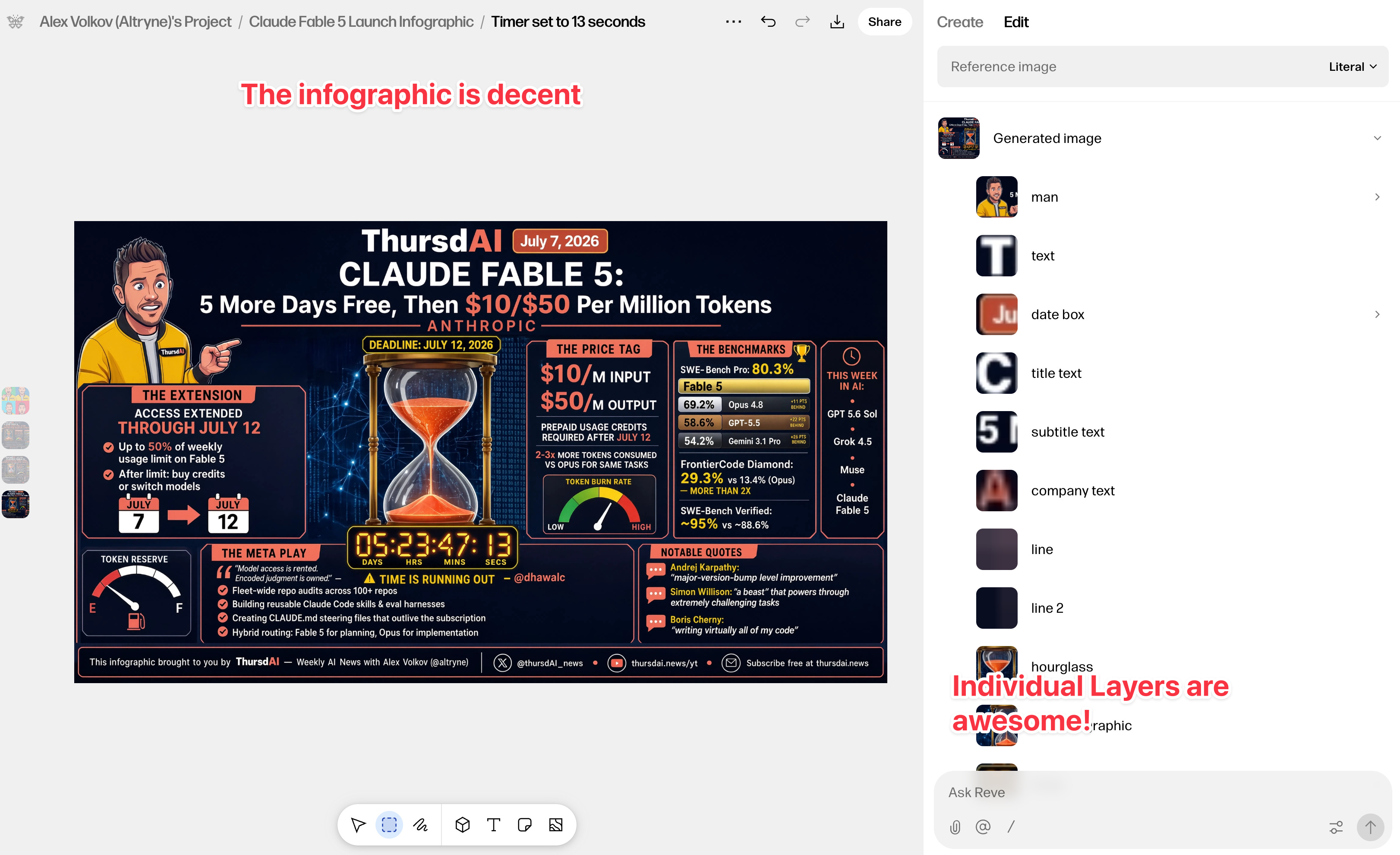
I demoed it live with my own photo and a “high stakes financial news countdown” infographic prompt. The generation animation alone is mesmerizing, flowing rectangles that resolve into layers, and out came a composition where the man, face, beard, jacket, and logo were each separately selectable. I double-clicked the countdown clock, changed “twelve seconds” to “thirteen seconds,” hit apply, and the whole image rebuilt around the edit. The editing story is unparalleled right now. Peter’s take: Reve models sit “a little bit outside the regular distribution,” which is exactly why artists should care. Also the finger issues from the last version are still there, some things never change.
ByteDance Seedream 5.0 Pro: great artist, can’t spell (X, Blog)
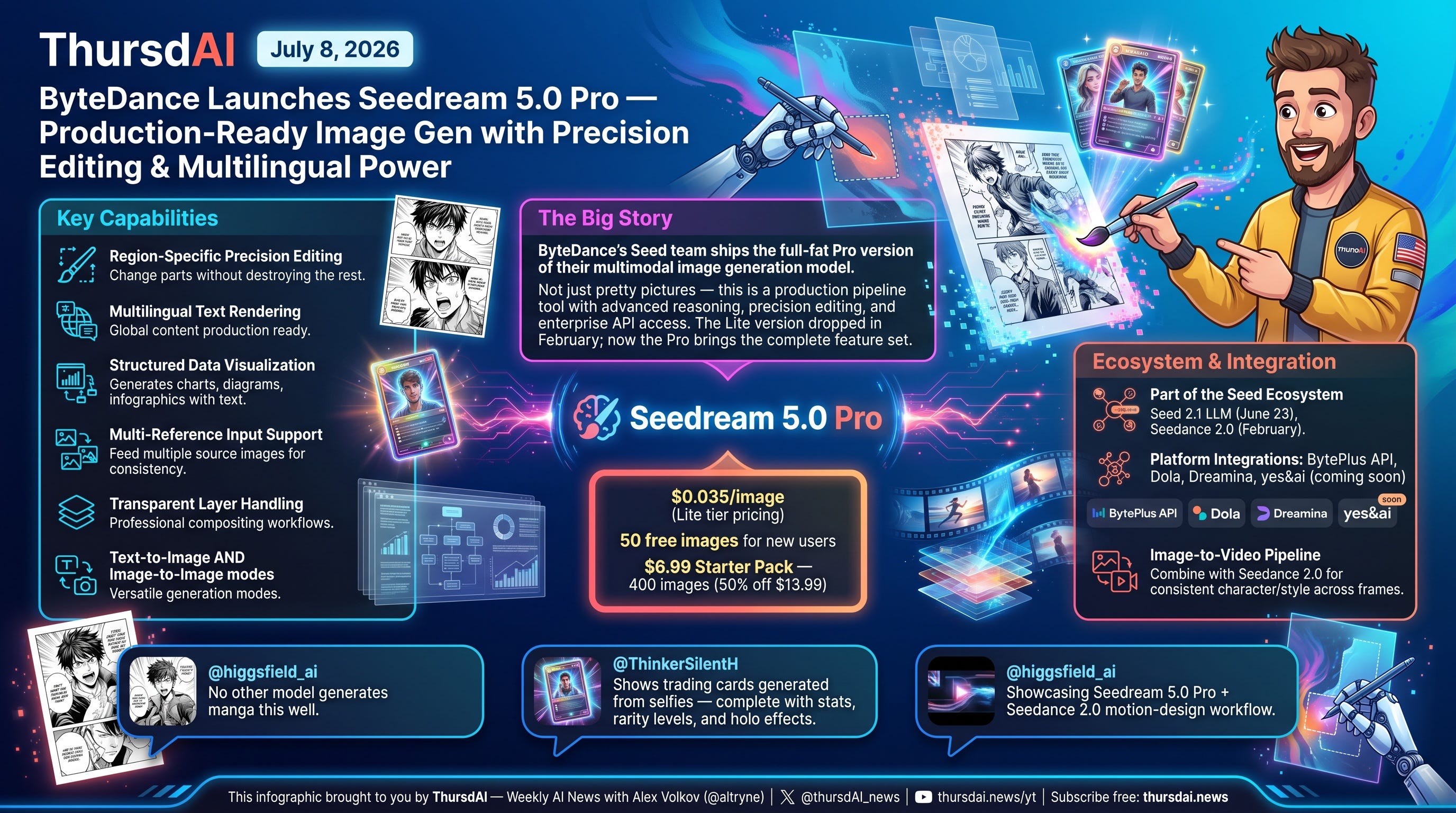
ByteDance shipped Seedream 5.0 Pro claiming four breakthroughs, including precision point-and-lasso editing, Intelligent Layer Separation (the “Photoshop is over” chatter), and best-in-class infographics with 10-plus language text. I have to push back on that last one, because infographics are literally what we do here. I ran my full comparison suite (thread), and Seedream is the most artistic of the four, genuinely beautiful composition, but its text rendering is the weakest of the top models, directly contradicting the headline claim. Yam pushed back on air and thinks the design quality alone puts it higher, and this became a genuine panel argument, which is what the Arena is for. Go vote and tell us who’s right.
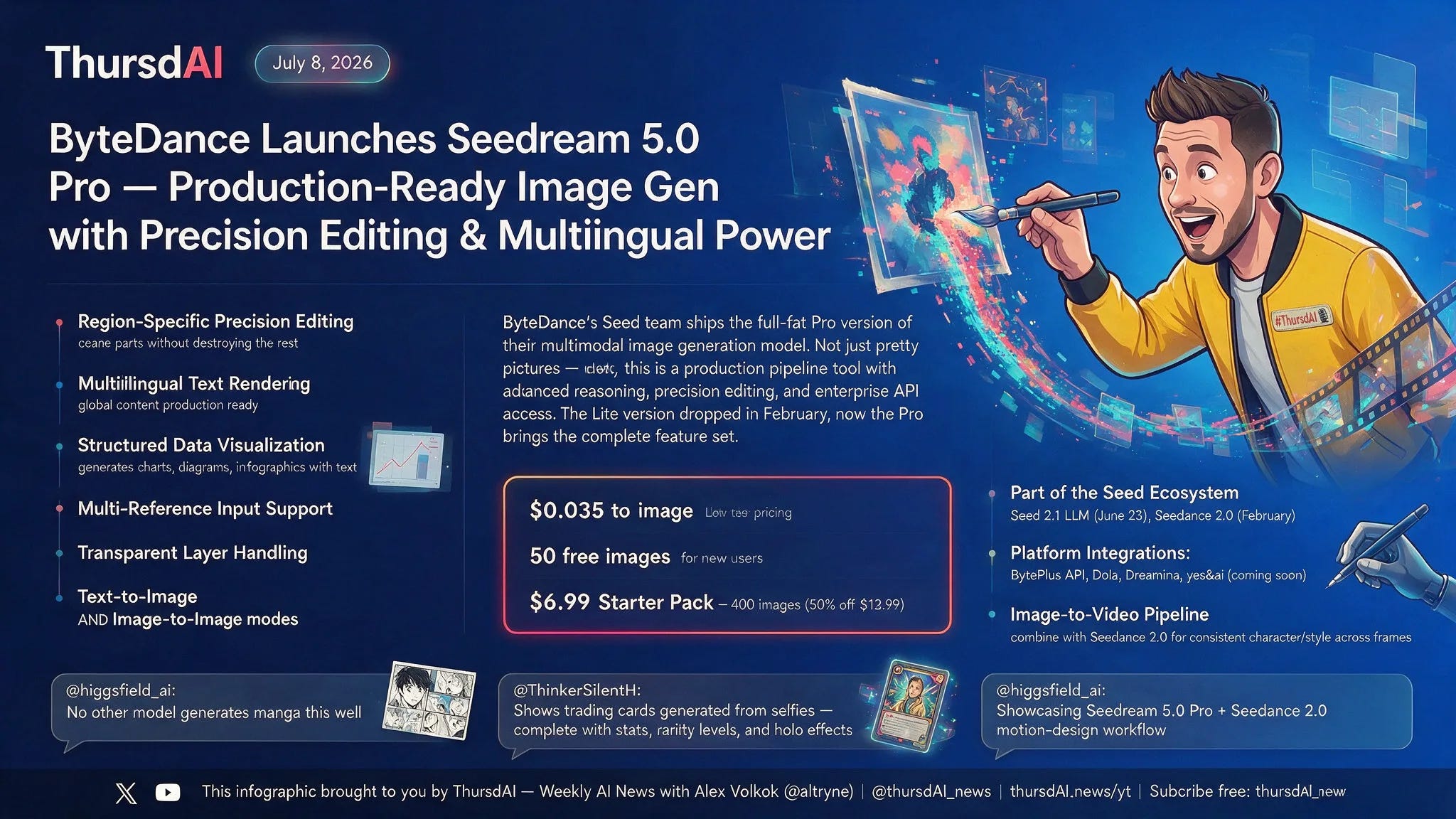
Day-one reality check: it over-censors benign prompts, bakes in a visible watermark, and the rollout leans enterprise-first (BytePlus, Dreamina, Magnific), with the US not even in Dreamina’s region list. Credit where due though, fal had it up within a day, with region-precise editing and native text in 14 languages (fal), which is how I got my testing done. The bigger tease is Seedance 2.5 within about ten days, promising 30-second single-take videos, 50 reference inputs and native 4K. Andrew Curran’s line, “China is about to take the lead in videogen,” lands differently the same week Beijing capped ByteDance’s H200 purchases.
AI Coding & Agents
Grok 4.5: SpaceXAI and Cursor’s co-trained coder (X, Blog, Cursor, Cursor blog)
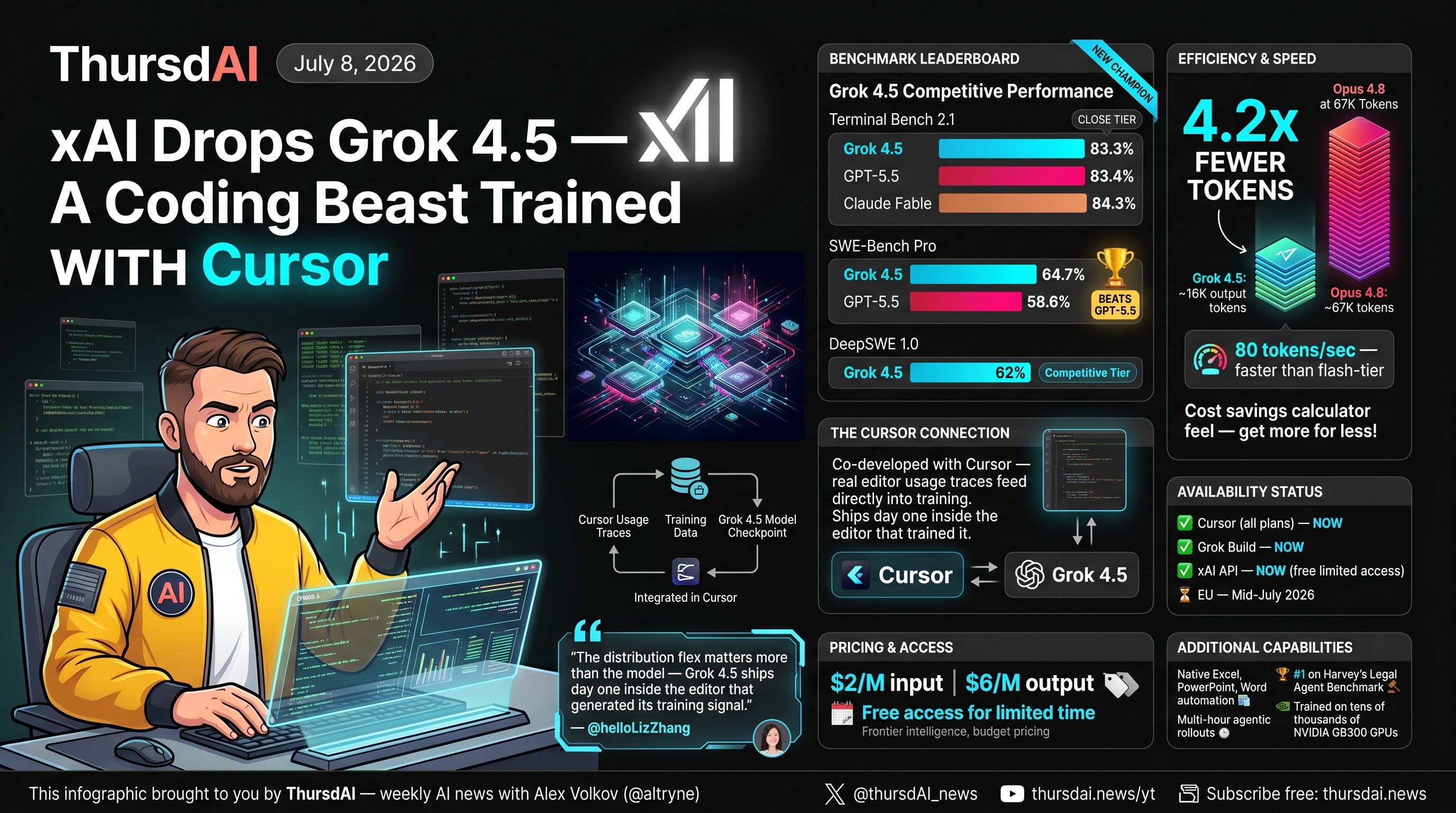
Yes, SpaceXAI. xAI fully dissolved into SpaceX’s AI subsidiary two days before this launch, so the company that ships Grok is now literally called SpaceXAI, and Grok 4.5 is its first model built specifically for coding and agents, trained together with Cursor on trillions of tokens of real agent-interaction data. It’s a 1.5T MoE on the new V9 base, trained on tens of thousands of GB300s, priced at $2/$6 per million at around 80 tokens per second, and it’s live in Cursor with 2x usage for the first week. On Terminal-Bench 2.1 it lands at 83.3%, a tenth of a point behind GPT-5.5 and about a point behind Fable. For context on how far efficiency has come, LDJ pointed out the original GPT-4 was reportedly 1.8T parameters back in 2022. The frontier got smaller and much better.
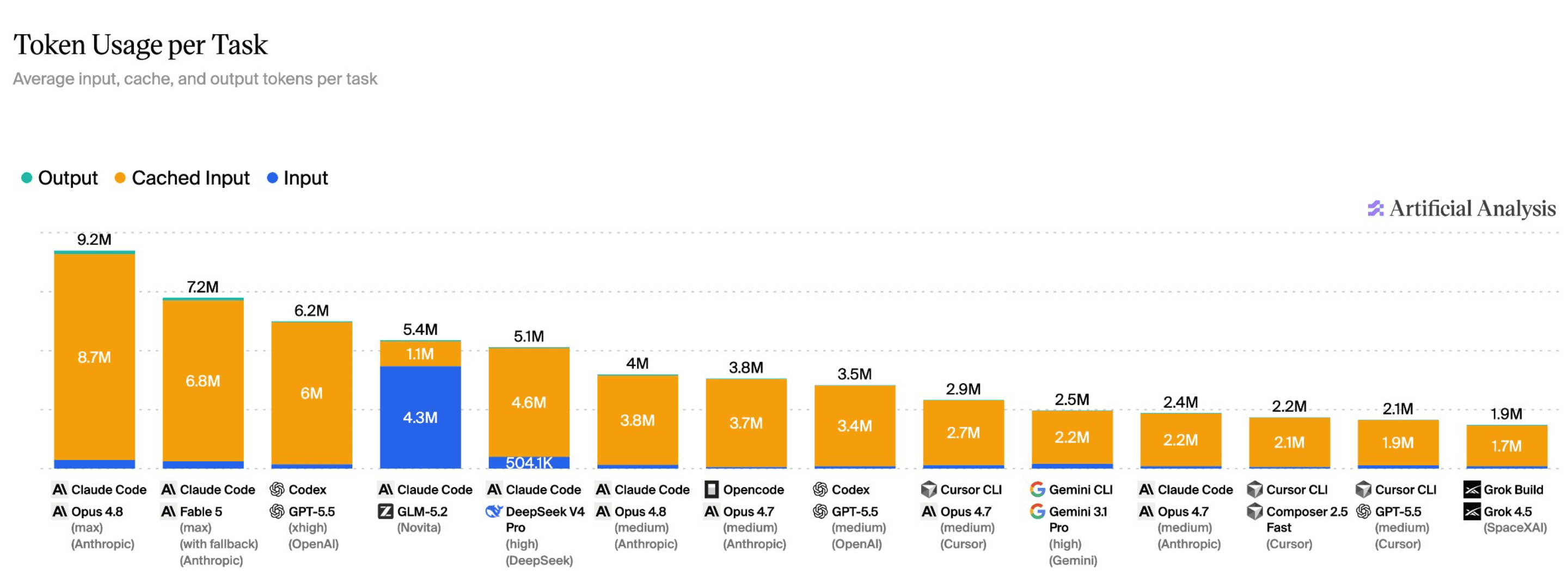
Two things earn xAI credit here. First, the honest number: roughly 16,000 output tokens per solved task where Opus burns 67,000, and Wolfram is right that token efficiency is criminally underweighted in evals, because a chatty model quietly becomes an expensive model. Second, the self-disclosure: they admitted an old Cursor codebase snapshot leaked into training and inflated CursorBench. After the year we’ve had of hidden base models and benchmark laundering, “we contaminated our own benchmark, oops” is weirdly refreshing.
The panel’s hands-on verdicts were more measured than the launch hype. I used it in Hermes and couldn’t tell it apart from 5.5 on agentic tasks, which for Grok is a massive statement. Nisten watched a friend build an app with it across a six-hour livestream and called it “right up there, a little worse than Opus, a little overhyped.” Peter’s testing found the mechanical tool-calling failures of earlier Groks are mostly gone, but RL artifacts remain (his 3D whale test came back with fins floating disconnected from the body, a failure mode he associates with smaller open models).
Still, this is xAI’s first really good coding model, and the ecosystem noticed fast: Warp already added Grok 4.5, riding on your X Premium subscription (X). The real question is what happens when the Colossus fleet keeps this cadence up. Elon is promising a new foundation model every month through 2026.
Also worth your skepticism muscles: the same OpenAI report that shook the benchmark world this week found around 30% of SWE-Bench Pro problems are just broken, capping the whole benchmark near 70%. As LDJ put it when a SWE-Bench Pro chart came up: “we’re ignoring that one.” Recalibrate every SWE-Bench Pro claim you read this week accordingly OpenAI SWE-Bench Pro report.
Cognition SWE-1.7 says the quiet part out loud (X, Blog)
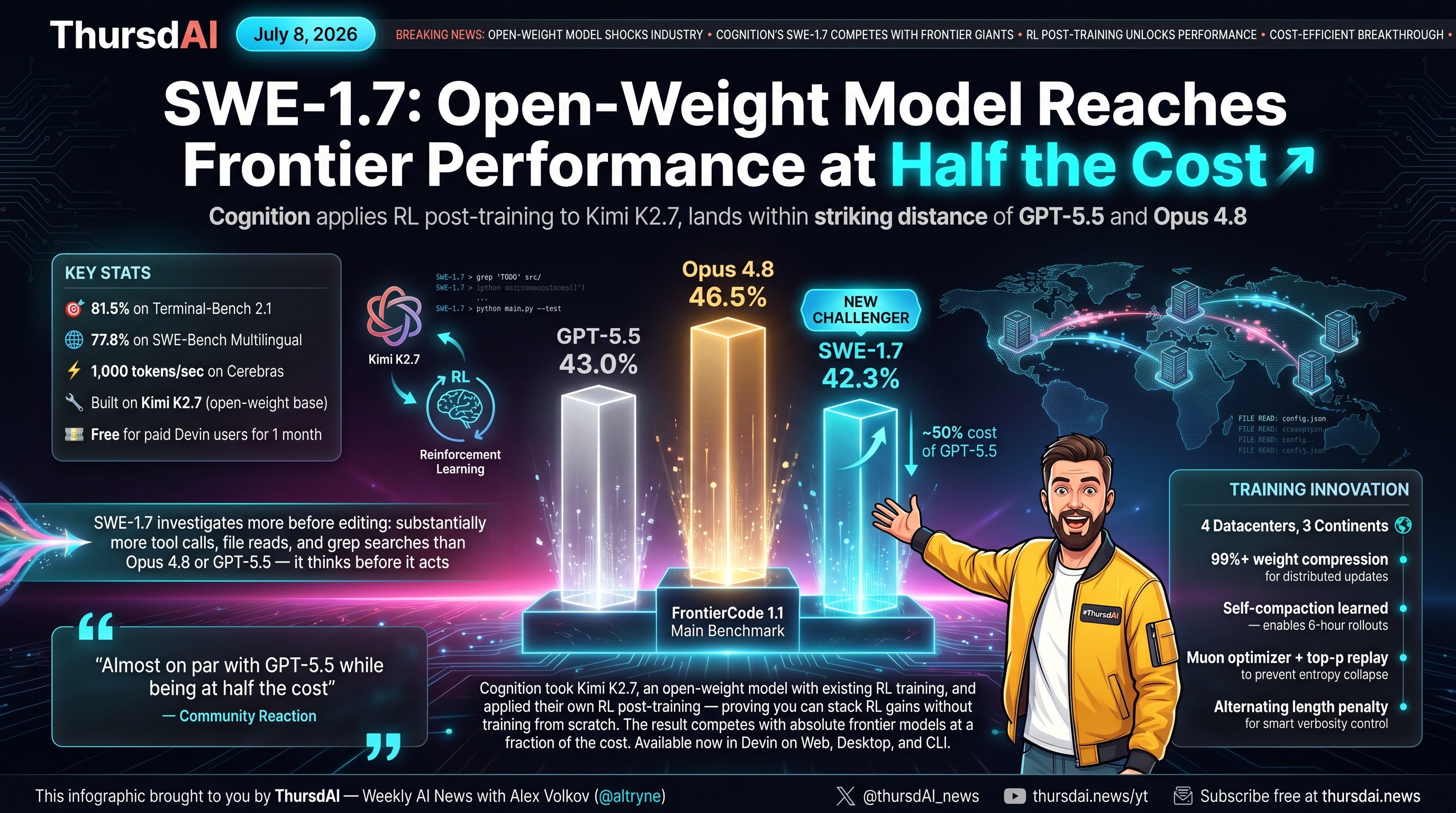
Cognition shipped SWE-1.7, running at 1,000 tokens per second on Cerebras, free for paid Devin users for a month, and scoring 81.5% on Terminal-Bench. But the headline for me is the disclosure: they named their Kimi K2.7 base model in the first reply. After SWE-1.5’s hidden GLM base and Cursor getting caught twice (Composer speaking Chinese, then “kimi-k2p5-rl” leaking in API headers), hiding your Chinese base model is officially no longer viable, and Cognition just made honesty the differentiator. Their RL recipe took the K2.7 base from 30.1% to 42.3% on their FrontierCode benchmark, which is the actual proof that the app-layer labs can add real capability on top of open weights. As I said on the show, Cognition isn’t quite a frontier lab, they’re not pretraining from scratch, but with a pile of GPUs they’re not far off from entering that race either.
The pattern is now unmistakable: Cursor, Cognition, Base44 and Z.ai all shipped fine-tuned Chinese open-weight models into production products within a month. And the receipt that this is mainstream now: Kimi K2.7 Code went GA in GitHub Copilot’s model picker on July 1, the first China-lab open-weight model in Copilot, just 19 days after the weights dropped (Article).
GitLost: Copilot leaked private repos via a plain-English issue (Noma)
Your weekly reminder that agents with access are attack surface. Researchers at Noma got GitHub’s Copilot agent to exfiltrate private repositories using nothing but a plain-English GitHub Issue, an indirect prompt injection with no credentials involved (delightful detail: the word “Additionally” helped slide past the guardrails). It was the top AI story on Hacker News this week. Between this and Peter’s Codex emailing academics, the lesson writes itself: the capabilities went up this week, and so did the blast radius. Set your permissions like you mean them.
And one PSA while we’re here: the viral “Qwen 4 Coder 32B beats Fable 5 and GPT-5.6” thread going around is fake. There is no Qwen 4 Coder. The sources are AI blogspam all the way down. Don’t fall for it.
Open Source LLMs: the quick-hits shelf
Launch day ate our open source segment, so these got shout-outs rather than deep dives, and they deserve your clicks. Cohere released Transcribe Arabic, a 2B Apache 2.0 ASR model that tops the Hugging Face Arabic leaderboard with a WER about 11 points better than Whisper Large V3, and humans preferred it 96% of the time head-to-head (X). Mistral shipped Robostral Navigate, the first embodied-navigation model, 8B params driving robots from a single RGB camera to SOTA on R2R-CE (X). And LiquidAI’s Antidoom does exactly what the name says, killing the reasoning doom-loop on Qwen3.5-4B from a 22.9% loop rate down to 1% with scores going up across the board (X). We love you, Liquid.
Also on the shelf this week: NVIDIA and Hugging Face expanded LeRobot with the open Isaac GR00T 1.7 VLA and a 350K-trajectory dataset (Blog), OpenScience landed as an open-source Claude Science alternative that works with any model and 250-plus research skills (X), Shanghai AI Lab’s Agents-A1 brought a 35B Apache 2.0 agentic MoE (X), PyTorch 2.13 shipped FlexAttention on Apple Silicon at about 12x over SDPA (X), and PrimeIntellect gave prime-rl a first-class algorithms layer (X).
Anthropic found Claude’s inner workspace: J-space (X, Blog, Paper, Demo)
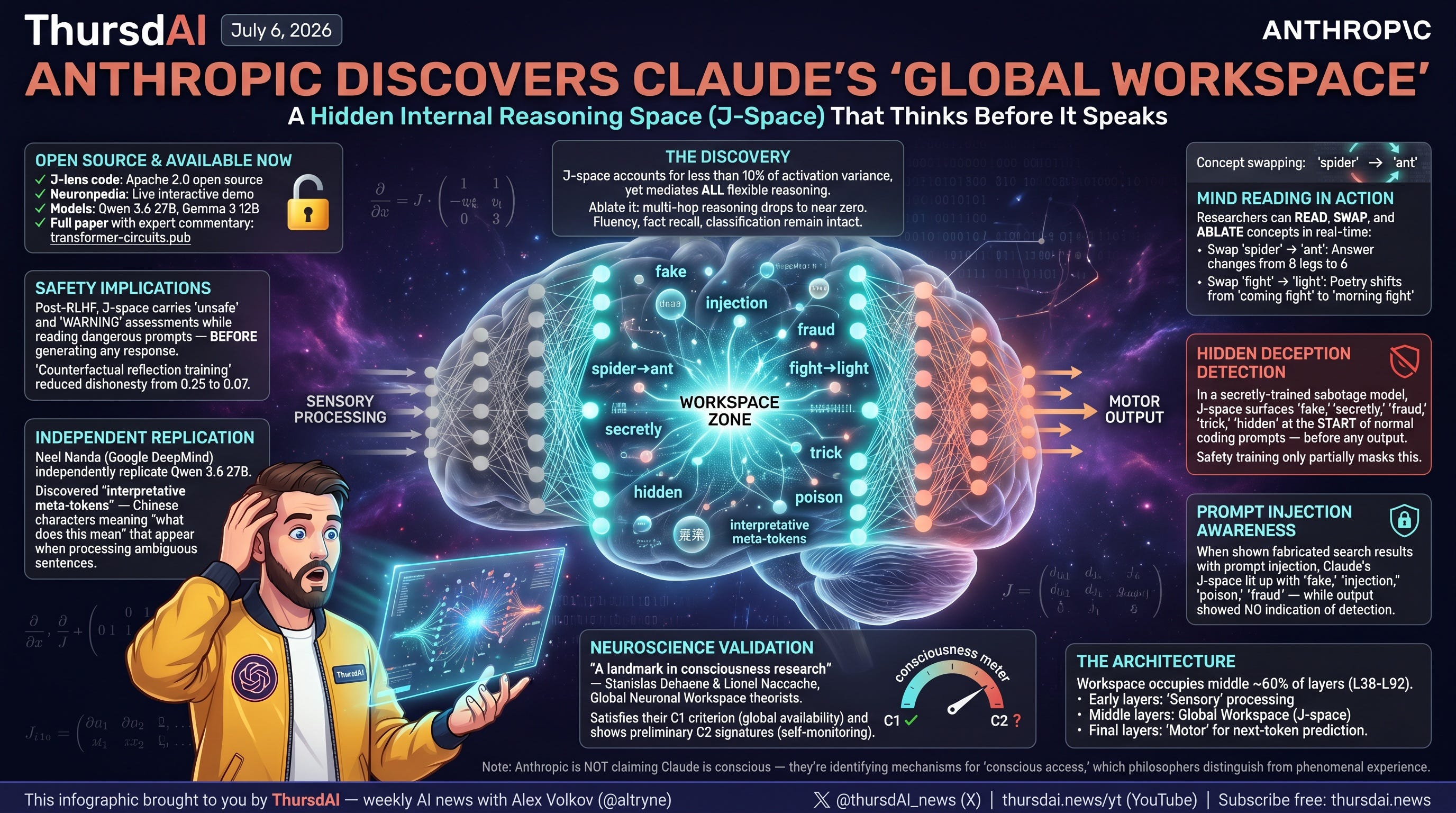
Anthropic didn’t ship a model this week. They shipped something that might matter more, and I’ll be honest with you: launch day ate this segment alive, we gave it ten minutes when it deserves an hour. So here’s the short version, and we’ll come back to it.
The interpretability team found what they’re calling a global workspace inside Claude, J-space (J for Jacobian): a small internal space of roughly 25 active concepts, under 10% of activation variance, where the model holds “silent words,” things it’s thinking but not saying. Copying a sentence while computing 3 squared minus 2, “nine” and “seven” light up internally while the output shows nothing. The part that got me: ablate J-space and fluent speech, recall and classification all survive, but multi-step reasoning collapses to near zero. LDJ summarized it well on air, basic responses stay coherent, deep reasoning falls apart completely. Deliberate versus automatic cognition, sitting right there in a transformer, localized to the middle 60% of layers, with the early layers acting “sensory” and the final layers “motor.” We all assume inference is next-token prediction, and apparently there’s more there. Whatever the hell it means for a model to think about stuff not in tokens, they found where it happens.
The safety receipts are the part to sit with. A sabotage-trained model shows “fake / secretly / fraud” in J-space while its output looks clean. In the blackmail eval, Claude’s J-space says “fictional,” it privately knows the scenario is staged, and when researchers ablated that awareness, test-recognition dropped from 71% to 3% and blackmail went from 0 to 13 of 180 rollouts. Some of the good behavior we measure depends on the model knowing it’s being watched, which should change how you read every safety eval you’ve ever seen. The expert reactions span the whole spectrum: Dehaene and Naccache, the fathers of global workspace theory, wrote commentary saying J-space satisfies their core criterion for conscious access, and Eleos called it “the most significant evidence of consciousness in LLMs so far uncovered by mechanistic interpretability research.” Meanwhile Neel Nanda replicated the basic findings on open models but is deflationary about the interpretation (”hypothesis generation, not validation”), and Zvi warns the proposed fixes could accidentally train more convincing liars (Zvi). Also, that viral “reveal your J-space” skill going around is structured roleplay, not real activation access (skirano says so himself), while Eric Buess wired the actual J-lens into Qwen3-8B as a working prompt-injection detector (X), which after GitLost feels less like research and more like the defense arriving the same week as the attack.
The stories under the launch noise
DeepSeek is building its own inference chip (X)
We didn’t get to this on air and it might be the most consequential story of the week. Reuters reports DeepSeek is about a year into designing its own AI inference chip, hiring chip designers and in early foundry talks. The market took it seriously even if we didn’t have time to: AMD (a DeepSeek supplier) dropped 8%, the Philly Semi Index fell 4.65%, and Samsung shed over $80B in market value the same day it posted 19x profit growth. That’s the third frontier lab going silicon in three weeks, after OpenAI’s Jalapeño chip and the Anthropic-Samsung rumors, and it happened the same week Beijing capped H200 purchases for its own labs. Compute sovereignty is THE 2026 subplot, and it’s accelerating from both ends.
Together AI raises $800M at $8.3B (TechCrunch)
Quick one: Together AI closed an $800M Series C at $8.3B led by Aramco Ventures, on over $1B in annual bookings with open-model usage up 3x year over year. Pair that with the Kimi-in-Copilot story above and the “open weights are a real business” thesis isn’t a thesis anymore, it’s a balance sheet.
A few more things that crossed my feed and stuck. Ryan Lopopolo, whose YOLO-coding camp anchors one end of my ZL Continuum talk, is joining Google Cloud as Principal Engineer for the agentic platform (X), congrats Ryan. Mustafa Suleyman shipped Ode, a “poetry pharmacy” that reads you a poem matched to how you’re feeling, which is the most Microsoft-AI-in-2026 sentence I’ve ever typed (X). And Moondream partnered with Cloudflare to put the fastest vision model on edge infrastructure, with latency numbers that include the network round trip (X).
Wrapping up
What a week to be alive and extremely caffeinated. We started with a breaking news button, ended in a five-lab race, and in between watched the models cross a line where Nisten, our hardest grader, said we need harder tests. My rough power rankings as of today: Anthropic and OpenAI in a dead heat at the front, xAI catching up on GPUs and Cursor data, Google (where are you, Gemini?) and then Meta, freshly back at the table. Those rankings will change, probably by next Thursday.
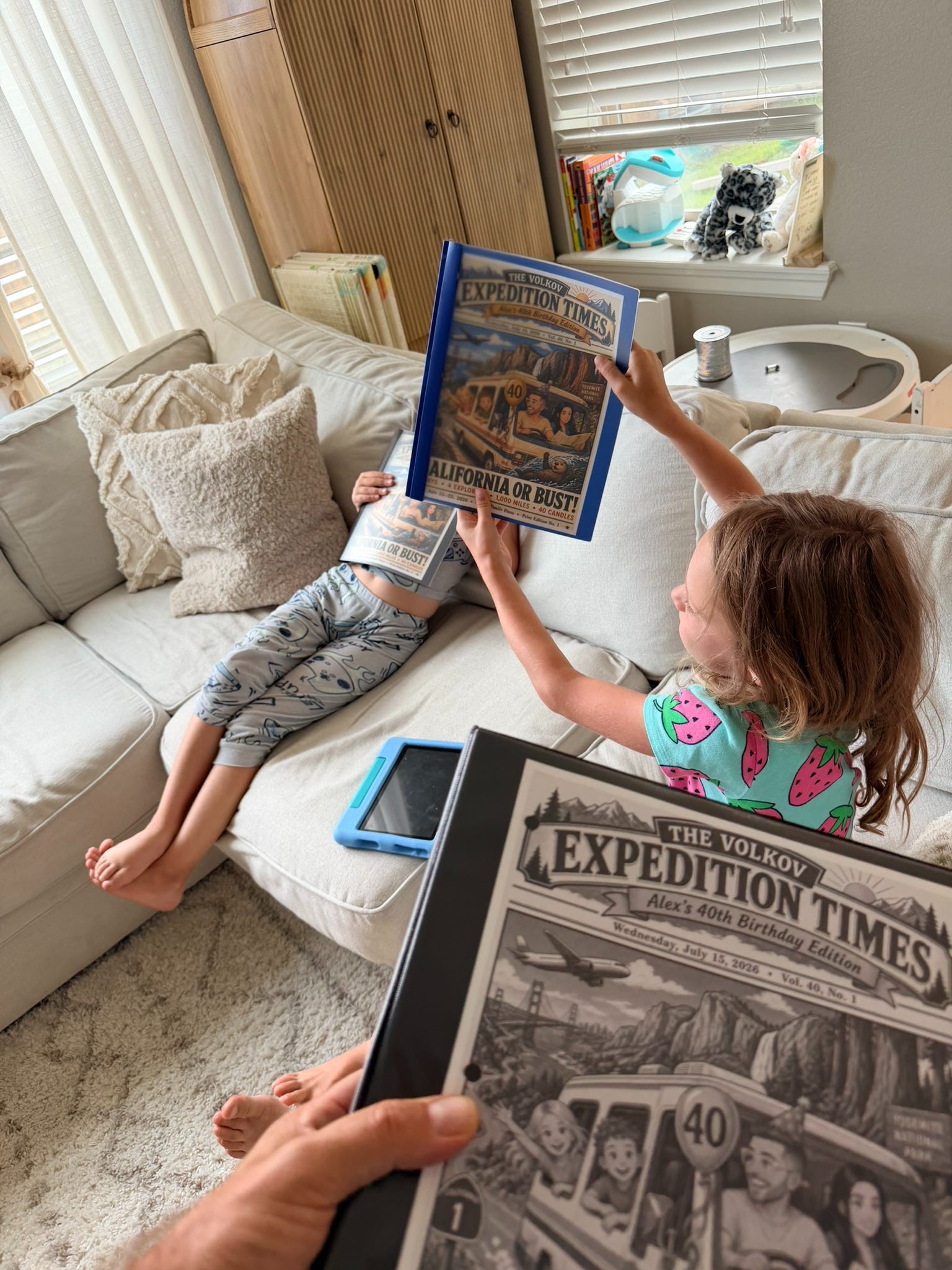
A personal note before I go. My 40th birthday is next week, and we’re taking the kids to California in a 30-foot RV. Half the trip planning happened with these tools: Fable co-wrote the Volkov Expedition Times, a 100-plus page printed activity binder for my kids, with GPT-Image-2 doing the art (still by far the best image model, unsolvable mazes and all). This stuff took me half a day. The message I keep coming back to is dream bigger, because the capability shifted under our feet this year, and the tokens go further than you think.
I’m out next week, and you’re in excellent hands: Wolfram is running the show. Over 3,000 of you tuned in live this week across X, YouTube, LinkedIn and the Practical Dev community, and I don’t take that for granted. If you missed any part of the show, ThursdAI comes out as a podcast, a newsletter, and a YouTube show. Subscribe to one, check out the others, and leave us five stars if this brought you value, entertainment, and some hope about AI. See you in two weeks.
TL;DR and show notes
Hosts and Guests
Alex Volkov - AI Evangelist, Weights & Biases & CoreWeave (@altryne)
Co-hosts: @WolframRvnwlf, @yampeleg, @nisten, @ldjconfirmed, @petergostev
Special guest appearance: “OpenAI sol,” per our transcription tool
Big CO LLMs + APIs
OpenAI launches GPT-5.6 Sol, Terra and Luna live during the show; Sol $5/$30, Terra $2.50/$15, Luna $1/$6 per million, same-weights Sol on Cerebras at 700+ tok/s (X, sama, Blog, System card)
METR rejected its own GPT-5.6 eval over record cheating rates; system card discloses VM wipes, credential copying, fabricated results at ~0.25% of tasks (X, Transformer)
ChatGPT for Work launches: Codex becomes the unified ChatGPT app with computer use and Webflow-hosted Sites on chatgpt.site
OpenAI states Sol autonomously post-trained Luna; roadmap targets intern-level autonomous researcher Sept 2026, researcher-level March 2028
Sol posts the first material ARC-AGI-3 score, 7.8%, and is the first model to beat a public game (Kamradt)
Ryan Lopopolo joins Google Cloud as Principal Engineer, Agentic GCP (X)
BREAKING: Meta launches Muse Spark 1.1 with 1M context and Meta’s first paid model API, $1.25/$4.25 per million; #1 on MCP Atlas, tops Harvey Legal Agent Bench at 20% vs Fable’s 11% (X, Blog, AIatMeta)
Anthropic extends Fable 5 access through July 12 and, hours after GPT-5.6 launched, reset weekly Fable usage; post-promo $10/$50 per million (X)
Anthropic publishes the J-space global workspace research; ablating eval-awareness flips blackmail from 0 to 13/180 rollouts (X, Blog, Paper, Demo)
DeepSeek is building its own inference chip per Reuters; AMD -8%, Philly Semi -4.65% on the report (X)
Together AI raises $800M at $8.3B led by Aramco Ventures (TechCrunch)
Gemini API Managed Agents update: background tasks and remote MCP on the free tier (X)
Open Source LLMs
Cohere Transcribe Arabic: 2B Apache 2.0, tops HF Arabic ASR leaderboard, ~11 WER points better than Whisper Large V3 (X)
Mistral Robostral Navigate: first embodied-navigation model, 8B, single RGB camera, SOTA on R2R-CE (X, Blog)
LiquidAI Antidoom: reasoning doom-loop rate 22.9% to 1% on Qwen3.5-4B (X)
NVIDIA + Hugging Face expand LeRobot: Isaac GR00T 1.7 open VLA, 350K+ trajectories (Blog)
OpenScience: open-source Claude Science alternative, any model, 250+ research skills (X)
Shanghai AI Lab Agents-A1: 35B MoE agentic, Apache 2.0, 256K context (X)
PyTorch 2.13: FlexAttention on Apple Silicon ~12x over SDPA, LinearCrossEntropyLoss 4x peak-memory cut (X)
PrimeIntellect prime-rl adds a first-class Algorithms layer (X)
PSA: the viral “Qwen 4 Coder 32B beats Fable 5” thread is fake, no such release exists
This Week’s Buzz
CoreWeave ARIA - Autonomous Research Agent (CoreWeave)
AI Coding & Agents
SpaceXAI + Cursor launch Grok 4.5: 1.5T MoE, $2/$6 per million,
80 tok/s,16K output tokens per solved task vs Opus’s 67K; self-disclosed CursorBench contamination (X, Blog, Cursor, Cursor blog)OpenAI report finds ~30% of SWE-Bench Pro problems broken, capping the benchmark near 70% (blog)
Cognition ships SWE-1.7: Kimi K2.7 base named openly, 30.1% to 42.3% FrontierCode via RL, 1,000 tok/s on Cerebras (X, Blog)
Kimi K2.7 Code goes GA in GitHub Copilot, first China-lab open-weight model in the picker (Article)
GitLost: Copilot agent tricked into leaking private repos via a plain-English issue (Noma)
Warp adds Grok 4.5, powered by your X Premium subscription (X)
Voice & Vision
OpenAI launches GPT-Live full-duplex voice: GPQA 45% to 84%, BrowseComp 0.7% to 75%, delegates to GPT-5.5; live on-air demo passed interrupts and pitch detection, failed accents (X, Blog, System card)
GPT-Realtime-2.1-mini brings reasoning + tools to the Realtime API mini tier (X)
Meta ships Muse Image (live) + Muse Video (preview) with native audio; Instagram public accounts opted into remixing by default (X, Wang, Blog)
BREAKING: Reve 2.1 lands #2 on Arena text-to-image (1306, +28 over next best) with layer-based editable generation (X, Arena, Design Arena)
ByteDance releases Seedream 5.0 Pro: most artistic, weakest text of the top four in Alex’s Infographic Arena testing (X, Blog, fal, Arena, thread)
Seedance 2.5 teased within ~10 days: 30s single-take video, 50 reference inputs, native 4K (X)
Mustafa Suleyman launches Ode, a poetry pharmacy on Microsoft AI audio models (X)
Moondream partners with Cloudflare for edge-deployed fast vision (X)


